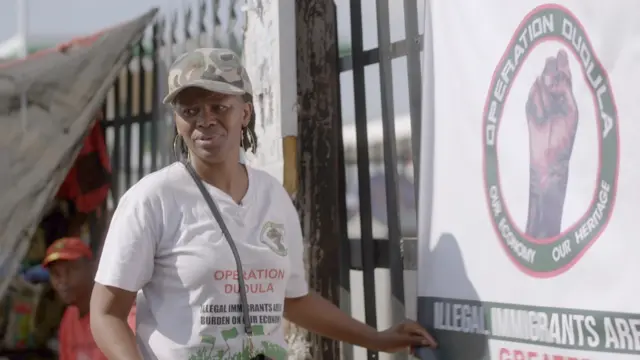
Government and Civil Society Unite Against Operation Dudula’s School Disruption Image: BBC News.
Operation Dudula and School Disruption: A Threat to Right to Education
(The Post News) – Operation Dudula activists have been accused of interfering with school operations, targeting migrant children in public schools in August 2024. The campaign has drawn criticism from Parliament and rights groups, who argue it violates the constitutional right to education. This clash between activism and learners’ rights has ignited national debate over schooling, immigration, and human rights.
Government Condemnation of School Disruption
The incident allegedly involved activists trying to prevent migrant students from attending classrooms in a number of Gauteng schools. On August 21, Makhi Feni, the chairperson of the Select Committee on Education, Sciences, and the Creative Industries, strongly denounced the activities in a statement. “We appeal for Operation Dudula activists to refrain from interfering with school operations, and we condemn their behavior,” he said. Learning time is crucial, particularly now that the preliminary and final exams are so near.
Feni cautioned that such disruptions in schools could cause stress to children and create opportunities for criminal elements to take advantage of the situation. He asked the group to refrain from using vigilante tactics and to follow constitutional processes.
Equal Education Speaks Out
Civil society has contributed as well. In a joint statement, Equal Education and the Equal Education Law Center referred to the campaign as a clear violation of the South African Schools Act (SASA), the High Court’s Centre for Child Law & Others v. Minister of Basic Education & Others case, and the Constitution. The organizations emphasized that schools must continue to be secure learning environments free from prejudice and xenophobia.
“Governmental institutions create a climate of violence and fear that disrupts learning for all learners, regardless of nationality, when they turn a blind eye to or tacitly support xenophobic intimidation in schools,” the statement added. Schools shouldn’t be places of bigotry and division, but rather safe places for learning.
The Right to Education is Non-Negotiable
Every child is guaranteed access to a basic education by Section 29 of the South African Constitution, which enshrines the right to education. Legal experts contend that any kind of intimidation or exclusion compromises this fundamental right and may create a risky precedent.
The Need for Coordinated Action
To avoid such disturbances, government agencies, non-governmental organizations, and school governing bodies are now working together. Makhi Feni reaffirmed that in order to protect students, the government must operate within the bounds of the law while simultaneously enforcing it when required.
Effects on Learners and Communities
Operation Dudula’s disruption of classes impacts not just migrant students but also South African students getting ready for important tests. Teachers caution that cutting back on class time may affect matriculation scores and increase school disparities.
Operation Dudula must be permitted to disrupt education or infringe upon the right to education, as the government’s unambiguous position and civil society’s forceful denunciation make abundantly evident. Authorities must protect students and make sure that schools continue to be learning environments rather than political battlegrounds as the examinations get near.
About the Author