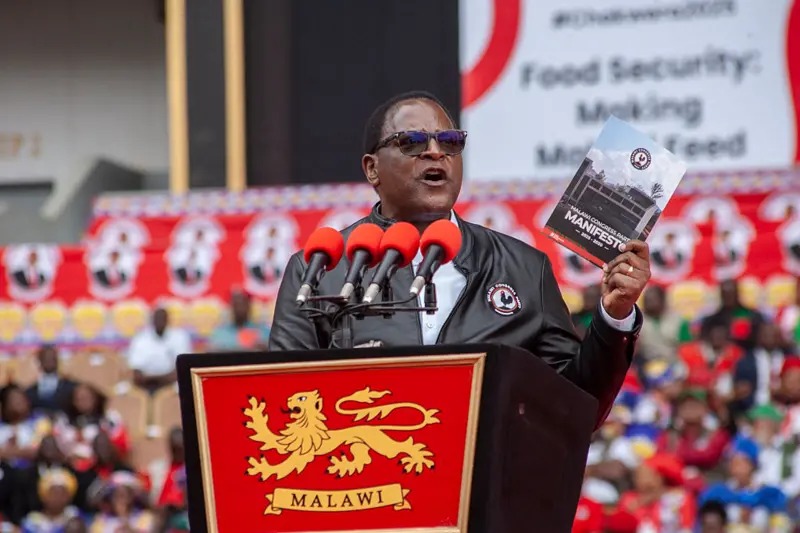
Newly elected Malawi president Arthur Peter Mutharika. Image credit: BBC News.
(The Post News) – The Chairperson of the African Union Commission, H.E. Mahmoud Ali Youssouf, has congratulated Professor Arthur Peter Mutharika on his victory in the General Elections in the Republic of Malawi. In a statement on Thursday the commission commended all the people of Malawi for their enthusiastic, peaceful, and orderly engagement in this credible democratic process across the election cycle.
Mutharika who is 85-years-old has made a dramatic return to the country’s politics. He has been declared as President-elect following the heavily contested 16th September elections. He defeated outgoing President Lazarus Chakwera. Chakwera has also conceded defeat and congratulated Mutharika.
According to the Malawi Electoral Commission (MEC), Peter Mutharika got 56.8% of the vote compared with 33% for Lazarus Chakwera. By putting Mutharika back in power, voters in the country seem to have concluded that life was better during his first term.
Youssouf applauded H.E. President Lazarus Chakwera and the Presidential candidate of the ruling Malawi Congress Party for conceding defeat, even before the official announcement of the results.
Malawi’s New President Background
Peter Mutharika is the son of a schoolmaster and brother to former president Bingu wa Mutharika, who was in office from 2004 until he died in 2012. Although he was born in Thyolo, Malawi, Mutharika spent his adult years in the United States teaching international law as a Yale-trained lawyer.
He was eventually introduced to African politics by his older brother, entered the Malawian parliament in 2009, and within three years he found himself having to fill his brother’s boots and lead the Democratic Progressive Party after Bingu died.
Two years later he was made president in 2014, serving his first term filled with a lot of victories and a ton of errors and complaints. Economically, he stabilized the country, stabilizing the kwacha, lowering inflation, and helping get loans to build critical infrastructure like “roads, power plants, and universities.”
The new president can be sworn in only seven days after the official results are declared but within 30 days, the MEC said.
About the Author