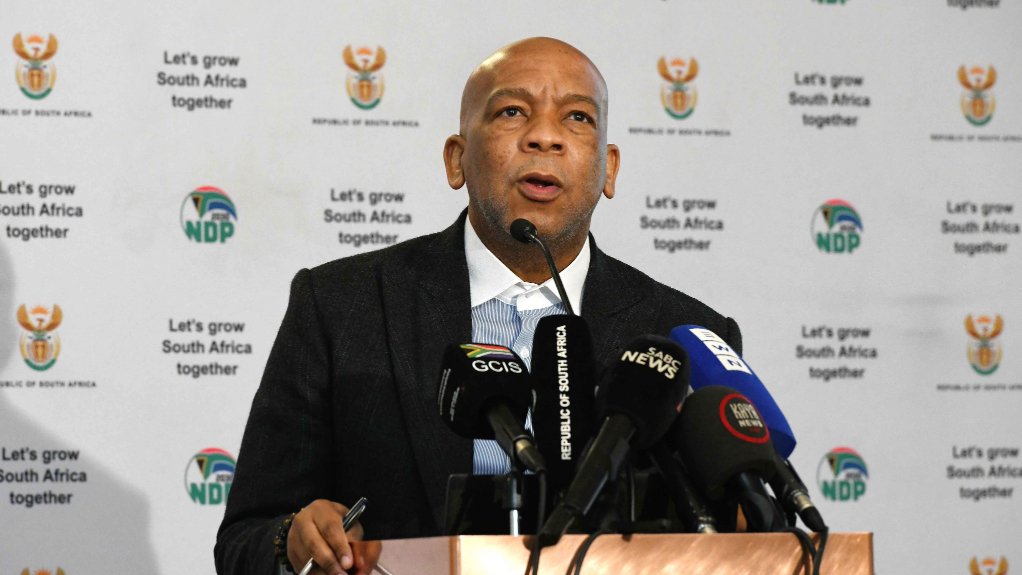
Government working to slash electricity prices says Electriciy Minister Ramokgopa. Image: EWN.
(The Post News)- Electricity and Energy Minister Kgosientsho Ramokgopa says government is taking decisive steps to make electricity more affordable for South Africans, signalling the end of steep price hikes that have burdened households and businesses for more than a decade.
Minister of Electricity announced on Thursday, 16 October 2025 before the National Council of Provinces that his department is finalising a review of South Africa’s electricity pricing policy, which is expected to be completed by March 2026. “We are getting to a stage where we are able to find a price path.
“We really want to get into the domain of price increases that are benchmarked relative to inflation,” stated RamoKgopa.
The Minister added that stabilising electricity prices is key to restoring confidence in government’s energy policy. “Finding a price path will increase confidence levels surrounding the government’s projections for future electricity price increases,” he said.
According to the Minister, Eskom’s electricity tariffs have increased by 937% since 2007, while inflation over the same period was 155%. “I’ve made the point publicly. I’ve shared with Eskom that the era of double-digit price increases is over,” he said.
He then described the current cost of electricity as “untenable,” warning that it has become an “existential problem” for many households and businesses. “Electricity has now reached the point where the situation is untenable. Households are finding it difficult to keep up with the increases and the rapid erosion of their disposable income. Companies are also increasingly becoming less competitive,” he said during Eskom’s latest State of the System media briefing.
Ramokgopa Unveils Nuclear Industrialisation Plan
Ramokgopa unveiled a new Integrated Resource Plan (IRP) on Sunday, 19 October 2025, along with ambitious gas and nuclear targets, reporting that it will ensure affordable and reliable power is critical for South Africa’s economic recovery. “Our economic prosperity hinges on a stable power grid,” he said, noting that years of rolling blackouts have cost the country investment, growth, and thousands of jobs.
Ramokgopa added that the upcoming policy review will not be confined to “smoke filled boardrooms” but will involve extensive public engagement. “It must go to every corner of the country,” he said.
He stated that the Government plans to invest R2.2 trillion, which is about 30% of the nation’s gross domestic product (GDP), in a comprehensive energy transformation strategy. “As a result of the lights being off, the South African economy has not been able to grow, as they say in economics. Electricity has been a structural constraint to the South African economy,” Ramokgopa said at a Sunday media briefing.
The Minister also stated that the persistent power shortages have stunted economic development and contributed to high unemployment rates. “Now that we have turned the corner on load shedding, we are addressing the future. Energy now ceases to be a crisis; energy and electricity are going to be a catalyst for growth,” Ramokgopa said.
It is reported that the IRP aims to address electricity supply issues, promote economic growth, and create jobs, targeting a 3% GDP growth by 2030. “There is no economy that grows if the lights are off. There are no industries that will decide to locate in South Africa if we can’t guarantee them available electricity that is of good quality and that is affordable,” he said.
The move also introduces a dramatic shift in the country’s energy mix, with cleaner energy sources like hydro, nuclear, wind, and solar set to surpass coal for the first time in the nation’s history. By 2039, the government aims to add 105 000 megawatts of new generation capacity effectively building Eskom “two and a half times” its current size.
His plan include, “11 270 megawatts of solar photovoltaics (PV) by 2030; 7 340 megawatts of wind energy; 6 000 megawatts of gas-to-power, and 5 200 megawatts of new nuclear capacity. We’re talking about growth, industrialisation, new skills, and resuscitating collapsed industries,” he said.
About the Author