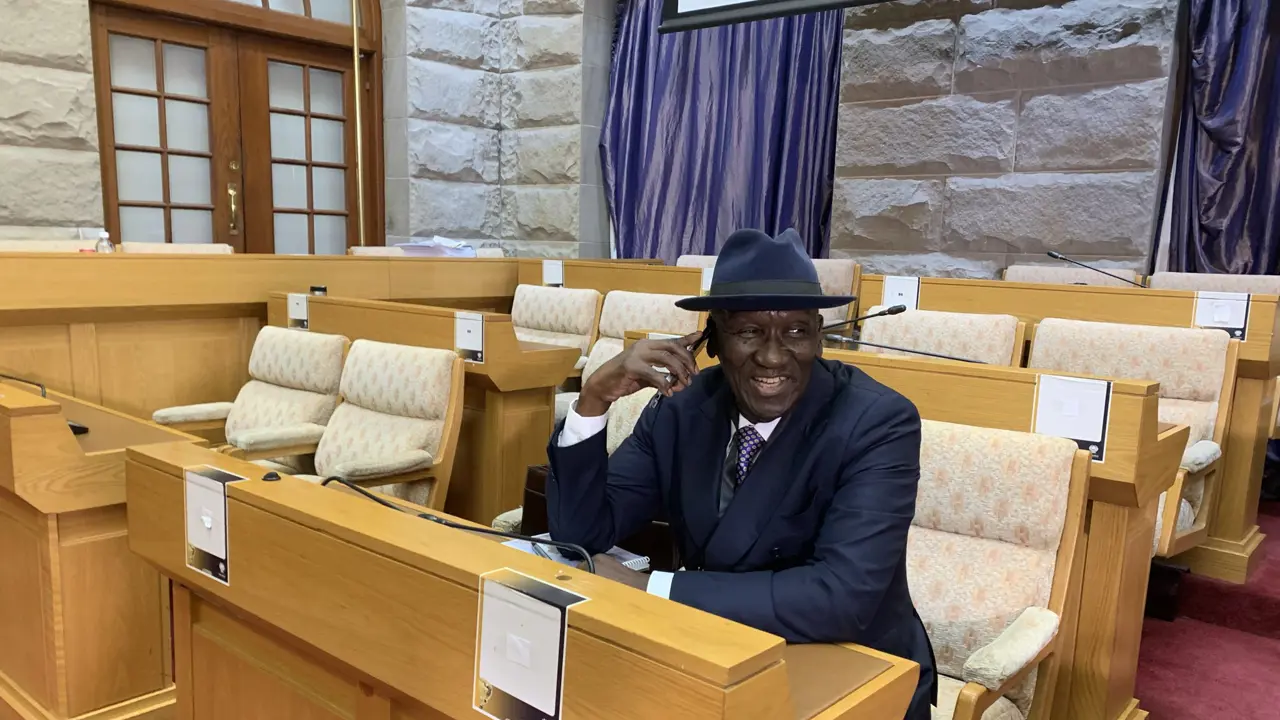
Bheki Cele before the Ad Hoc Committee. Image: Babalo Ndenze/EWN.
(The Post News)– Former police minister Bheki Cele says he found it puzzling that Police Minister Senzo Mchunu disbanded the Political Killings Task Team (PKTT), insisting that Mchunu did not have the authority to do so.
Cele was testifying before the Parliament’s ad hoc committee this week, where he defended the value and relevance of the team. This comes after Mchunu appeared for three days before the committee, defending that he was permitted to dissolve the task team.
Mchunu’s Allegation to Authority
Mchunu said it was within his legal authority as Minister of Police. “Task teams are typically established for specific objectives, timeframes, and resources,” Mchunu said, emphasizing that the task team had outlived its mandate.
He told the committee that the decision was based on operational assessments and departmental consultation, not political interference. “It was a routine practice once the mandate was fulfilled,” he added. Mchunu denied any links to criminal syndicates or political pressure, saying, “I deny having links to crime syndicates.”
“The continued existence of the team was no longer adding value to policing,” he said. He also recommended an audit of the team’s performance and accountability.
When asked about his knowledge of Brown Mogotsi, who was mentioned in related testimony, Mchunu said, “I’ve only recently become aware of him because he’s quite prominent in the media.”
Wrapping up his testimony, Mchunu said, “I struggled with some of the questions, but I stand by my decision.”
Cele Points Out IMC’s Final Authority
Cele told MPs that the task team was established under the authority of the Inter-Ministerial Committee (IMC), chaired by the president, and therefore could not be dissolved by a single minister.
He explained that the IMC was not a one-off political structure but a standing committee made up of ministries forming part of the multidisciplinary team. “I have heard submissions claiming that no IMC exists under the seventh administration—that is incorrect. The IMC continues to exist because it’s made up of ministries that form part of the multidisciplinary team, not individual ministers who may change with administrations,” Cele told the committee.
Cele added that he found it particularly confusing that Mchunu issued letters disbanding the task team late last year, even though ministers had reaffirmed its mandate in 2023. “On 5 September 2023, the IMC met and took a clear decision that the PKTT could not be dissolved and must continue,” he said. “Minister Lamola was directed to engage the NPA about dedicated courts for political killings, and we agreed that the team’s successes should be communicated publicly.”
Cele also said that as recently as early 2024, the task team was still functioning and had briefed the president on ongoing investigations. “As recently as March 7, 2024, the same team briefed the president on developments in the Fort Hare investigation. That shows the team was still functioning. The PKTT was formed for a reason, to address a specific crisis. Until those killings stop, the task team remains necessary. It’s not about politics; it’s about protecting lives,” Cele said.
Cele told MPs that the decision to disband the task team undermined ongoing investigations and left law enforcement officers uncertain about their responsibilities. “You cannot make such a unilateral decision. If there were concerns, the matter should have been raised with the IMC or in the JCPS cluster, co-chaired by the Ministers of Justice and Police. At the very least, clearance should have been sought from the president. The process should have followed the same route it took to establish the team in the first place,” Cele told Parliament.
About the Author