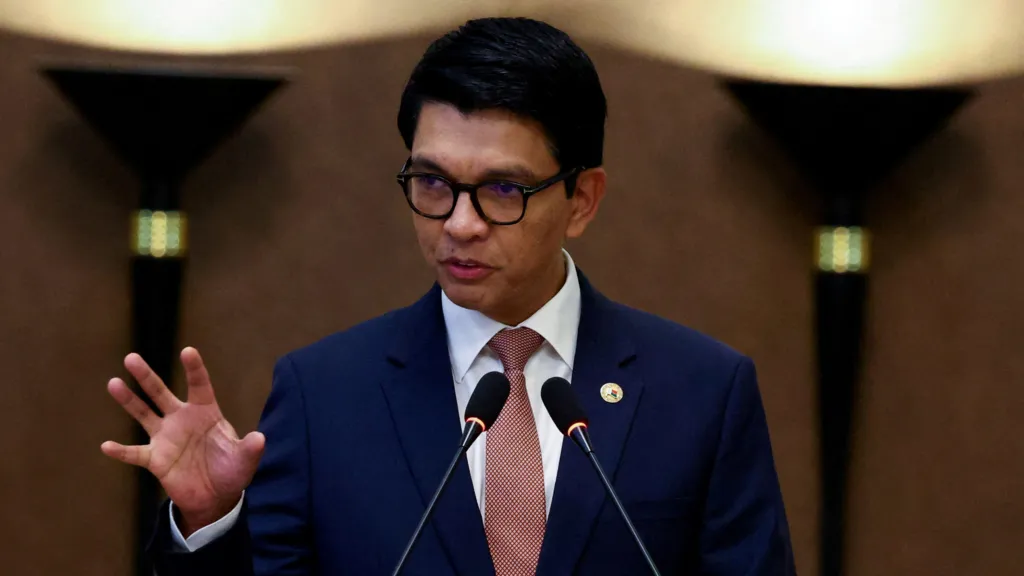
Madagascar's President Andry Rajoelina is hiding in a 'safe place' as he warns of a coup attempt. Image: Vijesti.
(The Post News)– Former Madagascan president Andry Rajoelina, who was deposed in a coup last week, has been stripped of his Malagasy citizenship by the country’s new leadership.
A decree issued by Prime Minister Herintsalama Rajaonarivelo stated that under national law, anyone who holds foreign citizenship automatically forfeits their Madagascan nationality.
Rajoelina, 51, became a French citizen about ten years ago, a fact that previously sparked controversy and demands for his exclusion from the 2023 presidential race. Despite the outcry, he proceeded to run and ultimately won the election.
Rajoelina’s Flight and Impeachment
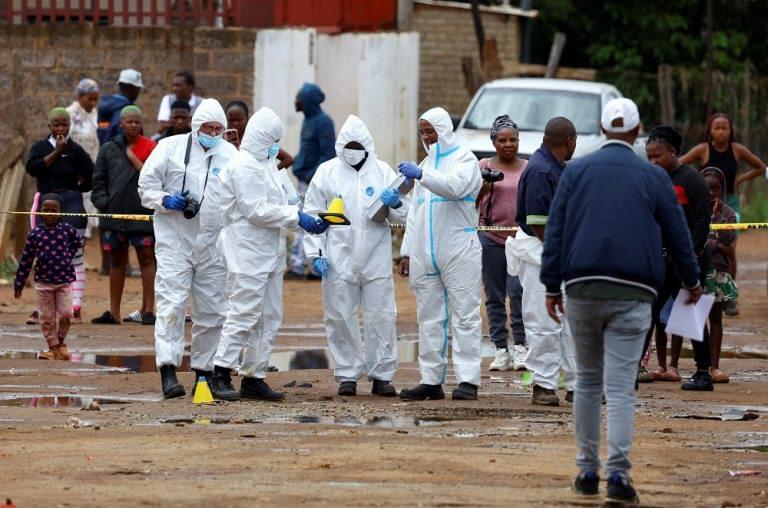
Rajoelina fled the country between October 11 and 12, 2025, citing “explicit and extremely serious threats” to his life. His departure came after weeks of youth-led protests over chronic electricity and water shortages, poverty, and alleged corruption.
The threats had come when he was due to travel abroad for a mission, a statement sent to AFP said. Reports had indicated that he left the country on a French military plane, in which he had said he was taking refuge in a ‘safe place’ without giving further details.
Rajoelina, who first came to power after a military-backed coup in 2009, had accused the National Assembly of colluding with the military to remove him from office.
The unrest culminated in calls for his resignation and pressure from a mutinous army faction. Despite his absence, Rajoelina was impeached on October 14, effectively ending his presidency.
In recent weeks, he had faced demonstrations initially organized by the youth movement Gen Z Mada and inspired by similar anti-government protests in Nepal, which were only exacerbated when his government responded with violence.
Military Takeover and Leadership Shift
The power vacuum left by Rajoelina’s departure was quickly filled by Colonel Michael Randrianirina, who led the military faction responsible for the coup. On October 17, Randrianirina was sworn in as president, suspending the constitution and assuming control of the government.
His rise to power was facilitated by the Army Personnel Administration Centre (CAPSAT), which stormed the Presidential Palace in Antananarivo. The Constitutional Court later proclaimed him as Madagascar’s new leader, despite the deposed president’s continued claim to power.
Randrianirina, who commands the nation’s most powerful military unit, remains an enigmatic figure, with little publicly known about his background or personal life.
Only hours before declaring his takeover, Randrianirina told the BBC that he considered himself simply “a servant of the people.” He displayed composure, personableness, and confidence, but without any hint of arrogance.
Randrianirina appointed businessman Rajaonarivelo as Prime Minister, citing his international connections and experience. However, this new leadership has faced widespread rejection from civil society, opposition groups, and many ordinary citizens who view the coup as illegitimate and undemocratic.
Regional and Global Condemnation
The African Union (AU) Peace and Security Council (PSC) reacted quickly to the political upheaval, suspending Madagascar from all AU activities on 15 October, citing an unconstitutional seizure of power.
The PSC urged a swift restoration of constitutional rule through an inclusive, civilian-led transition and fresh elections. Two days earlier, on 13 October, it had also directed AU Commission Chairperson Mahmoud Ali Youssouf to appoint a special envoy to the country and revive the 2011 political roadmap.
However, the AU’s decision to impose sanctions has sparked anger among many Malagasy citizens, who view the military junta as a legitimate authority that intervened to save the nation.
Meanwhile, the Southern African Development Community has responded to the situation in Madagascar by condemning the violence, urging calm and dialogue, and dispatching a mediation delegation.
About the Author