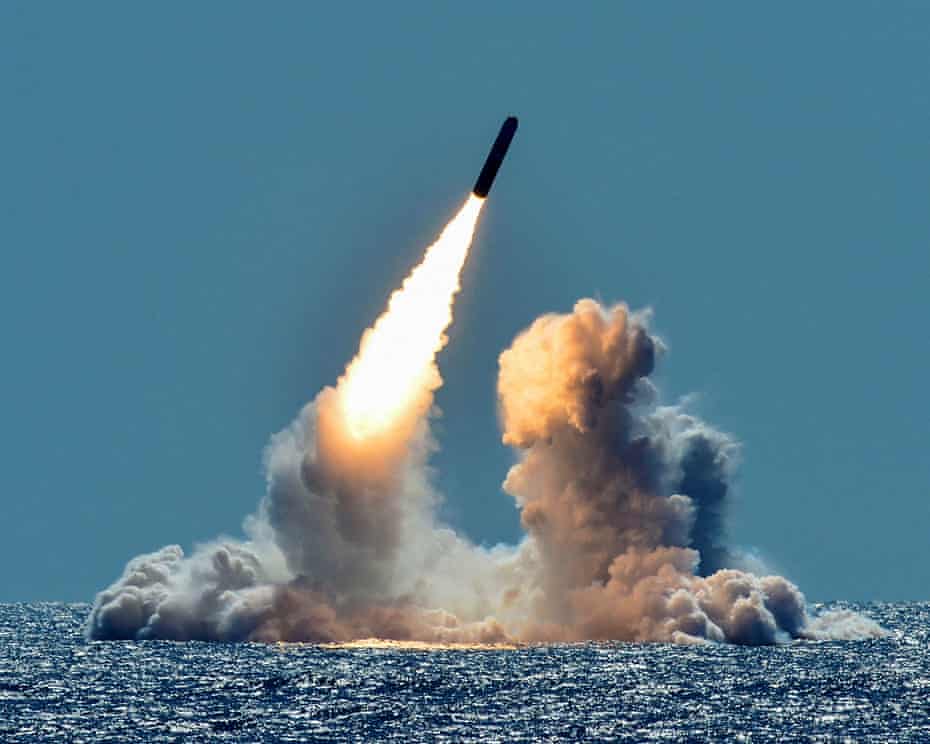
US president makes threat after Russian nuclear-powered weapons tests and shortly before meeting with Chinese leader. Image Credit: The Guardian.
(The Post News)- United State President Donald Trump has issued a go-ahead to Pentagon to resume testing Nuclear Weapons to match Russia and China’s weapon.
Decision follows China’s growing nuclear arsenal and Russia’s advanced weapons tests, signaling a new era of nuclear competition.
Trump Cites China and Russia as Justification for Breaking 30-Year Testing MoratoriumIn a dramatic shift in U.S. defense policy, President Donald Trump has authorized the Pentagon to resume testing of the nation’s nuclear weapons, effectively ending a moratorium that has stood since 1992.
The announcement, delivered via Trump’s social media platform just days before a high-stakes meeting with Chinese President Xi Jinping in Busan, marks a significant escalation in global nuclear rivalry. The president’s order comes amid growing alarm in Washington over China’s rapid nuclear buildup.
Analysts at the Center for Strategic and International Studies (CSIS) estimate that China’s arsenal could surpass 1,000 warheads by 2030, more than doubling its current size. Meanwhile, Russia continues to showcase its own nuclear advances, including recent trials of the Poseidon nuclear-powered super torpedo and a nuclear-capable cruise missile designed to evade missile defenses.
Trump argued that these developments leave the United States “at a disadvantage” in deterrence readiness, warning that “Russia is second, and China is a distant third, but will be even within five years.” His directive, though lacking operational details, signals a willingness to reignite a nuclear competition that many believed ended with the Cold War.
Experts remain uncertain about what form the testing will take. The Pentagon and the Department of Energy’s National Nuclear Security Administration (NNSA) have yet to clarify whether Trump’s directive involves subcritical experiments, hydrodynamic testing, or full-scale underground detonations the latter of which would violate the spirit of the Comprehensive Nuclear Test Ban Treaty (CTBT).
According to a 2024 Congressional Research Service report, a full resumption could take up to 36 months to implement, given technical and environmental safeguards.
Trump’s Decision Sparks Global Backlash and Heightens Fears of a New Arms Race
Reactions to Trump’s announcement were immediate and intense, both at home and abroad. In Washington, arms-control experts and several lawmakers condemned the decision as reckless and destabilizing.
“This could dismantle decades of nonproliferation progress and invite a dangerous cycle of reciprocal testing by other powers,” warned a former senior State Department official.
China’s Foreign Ministry urged the United States to “act responsibly” and maintain its commitment to international disarmament norms, while Russia dismissed the move as “provocative and strategically irresponsible.”
Within NATO, allies expressed deep concern that the decision could strain transatlantic unity and undermine existing security guarantees.Supporters of the president, however, argued that Trump’s approach is a necessary response to what they see as unchecked nuclear expansion by America’s rivals.
Strategic analysts warn that renewed testing could trigger a domino effect, prompting countries such as India, Pakistan, and North Korea to justify their own test programs.
The erosion of global testing norms could, they argue, make future arms-control diplomacy far more difficult.As things stand, the Pentagon is expected to prepare a technical proposal outlining possible testing sites and timelines. Congress is expected to hold hearings to scrutinize the legal, financial, and environmental implications of the president’s decision.
Trump’s upcoming summit with Xi Jinping once expected to focus on trade and technology is now likely to be dominated by questions of nuclear competition and strategic stability.
About the Author