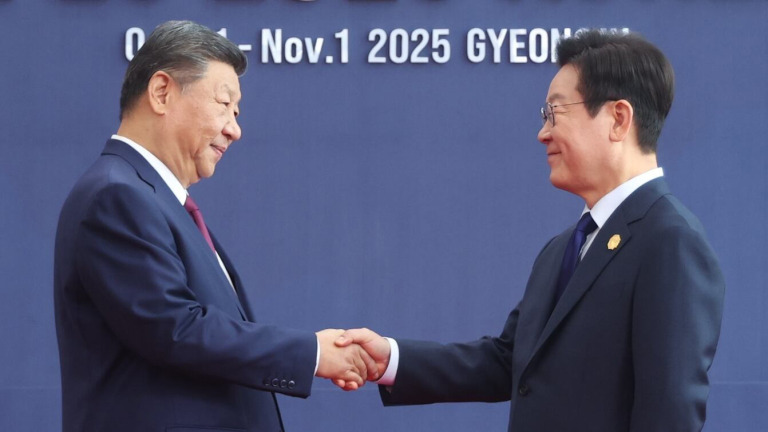
Chinese President Xi Jinping speaks at the 2025 APEC Summit in Gyeongju, pledging China's commitment to global free trade after U.S. President Donald Trump early departure [Image by Georgia Asian Times]
(The Post News) – Chinese President Xi Jinping pledged to preserve global free trade and strengthen multilateral cooperation at the APEC Summit in Gyeongju, South Korea. His message filled the vacuum left by the absence of U.S. President Donald Trump from the regional forum after twinning bilateral talks with Xi a day earlier.
“The more turbulent the times are, the more we need to work together,” he said at the meeting’s opening session. He urged that countries ought to stabilize supply chains, promote green energy, and combat protectionism. Investment openness and supporting the World Trade Organization (WTO) as the cornerstone of global commerce, Xi opined.
China Seeks to Lead as the U.S. Steps Back
Trump’s early leave and the absence of APEC are markedly contrasting in foreseeing the two leaders’ approaches, whereby Trump steals one-on-one deal-making, whereas Xi puts China as the everlasting guardian of the global trade network.
While Xi’s Hongqi limousine raced toward Gyeongju for two days of diplomacy as Air Force One departed from Busan, this split-screen moment encapsulated the changing global dynamics, wherein Washington retreats from multilateralism and Beijing is eager to fill in the leadership gap.
Xi urged that APEC members should “update international economic and trade rules” to better protect the interests of developing nations. He continued, “We must practice true multilateralism and enhance the WTO’s authority.”
During their meeting on that Thursday, Trump and Xi declared agreed-upon measures to limit tariffs, restore U.S. soybean exports to China, and ease restrictions on rare earth elements. Trump touted the consultations as a “roaring success” and evidence that his hardline trade measures worked.
Such agreements may have relieved markets, but analysts warned of deeper competition between the two powers. “The summit avoided the worst-case trade war scenario,” said Leif-Eric Easley, a professor at Ewha Womans University. “But APEC must be more than a venue for truce-it needs real collaboration on sustainable growth and digital innovation.”
In his first visit to South Korea in 11 years, Xi sought to enhance regional ties. On Friday, he held talks with Takaichi, Canadian Prime Minister Mark Carney, and Thai Prime Minister Anutin Charnvirakul.
Xi called for a “constructive and stable relationship fit for the new era” in his conversations with Takaichi. Takaichi expressed hope to alleviate persistent issues and take their dialogue to a deeper level. Analysts termed the meeting a thaw in relations, albeit against a backdrop of historical tension.
Xi is to meet South Korean President Lee Jae Myung on Saturday to discuss the North Korean nuclear issue and regional security cooperation.
As the host, South Korea called for unity from the 21 member economies, which account for almost 40% of the world population and more than half of global trade. Opening the summit, President Lee called for “constructive discussions” that prioritized shared prosperity over political rivalries.
Foreign Minister Cho Hyun admitted, however, that it would be challenging to formulate a strong joint statement in favour of free trade, given the divisions between the U.S. and China, and instead Seoul hopes for a broader declaration on peace, prosperity, and innovation.
A Test of APEC’s Relevance
Since its establishment in 1989, APEC has once stood for the growing trend of globalization. Presently, it stands challenged by strategic competition, ageing populations, and the impact of AI on jobs.
Yun Sun from the Stimson Center said, “China’s steady presence and the U.S.’s selective engagement highlight a new reality. Beijing is presenting itself as a reliable leader, but many are still circumspect about its trade practices.” As Trump embraces tariffs and unilateral deals, Xi’s message in Gyeongju was uncompromised: China intends to shape the next chapter of global trade-without or without America’s involvement.
About the Author