Russian Lieutenant General Fanil Sarvarov, head of the Operational Training Directorate of the Russian Armed Forces’ General Staff, was killed in a car bomb explosion in Moscow on Monday. The blast occurred when an explosive device detonated underneath his Kia Sorento vehicle in southern Moscow, severely injuring Sarvarov, who later died from his injuries.
Suspicions Points Towards Ukraine
The Investigative Committee, Russia’s top criminal investigation agency, has launched a probe into the murder, with suspicions pointing towards Ukrainian intelligence services. “Investigators are pursuing numerous lines of enquiry regarding the murder. One of these is that the crime was orchestrated by Ukrainian intelligence services,” said Svetlana Petrenko, spokesperson for the Investigative Committee.

Sarvarov, 56, was a career officer with decades of service, having gained combat experience in southern Russia, Chechen wars, and Russia’s military operation in Syria. He was appointed in 2016 to lead the department responsible for training senior officers.
The killing is the latest in a series of high-profile attacks on Russian military figures, including the December 2024 killing of Lt. Gen. Igor Kirillov, commander of Russia’s Nuclear, Chemical and Biological Defense Forces, who was killed by a bomb hidden in an electric scooter.
The incident has raised concerns about internal security vulnerabilities in Russia, with authorities examining multiple possible motives, including personal vendettas and state-sponsored sabotage. The Ukrainian government has not commented on the incident.
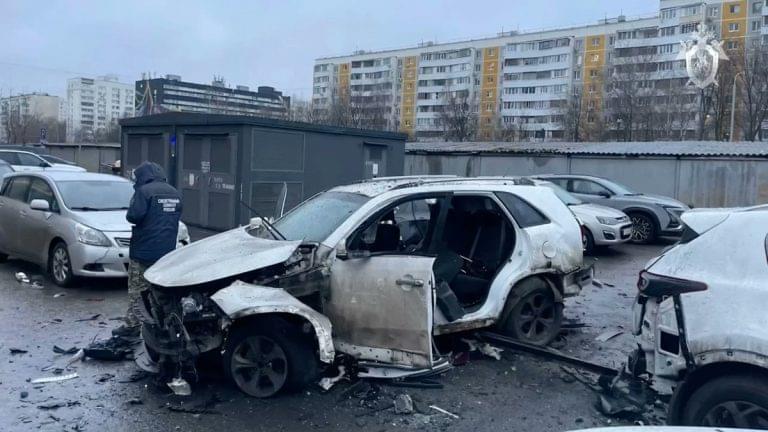
The blast site revealed a scene of devastation, with a white car damaged and debris scattered around. Investigators arrived promptly, combing the location for evidence amid a cordoned-off perimeter.
Kremlin Confirms The Death
Kremlin spokesman Dmitry Peskov confirmed that President Vladimir Putin was briefed immediately on the incident, signaling its gravity at the highest levels of government. The European Union has reiterated calls for de-escalation, emphasizing the need for diplomatic channels to prevent further violence.
The killing comes amid intensified fighting between Russia and Ukraine, with Ukrainian President Volodymyr Zelenskyy saying Russia launched around 1,300 attack drones and nearly 1,200 guided bombs over the past week.
Analysts suggest that assassinations like this erode the morale of Russian military leadership, potentially leading to internal purges or heightened paranoia within the ranks. Data from conflict monitoring groups indicate a 30% rise in targeted attacks on Russian officials since 2022.
The incident highlights the vulnerability of Russia’s security protocols and reflects the broadening scope of the war, spilling over into urban centers far from the front lines.
About the Author