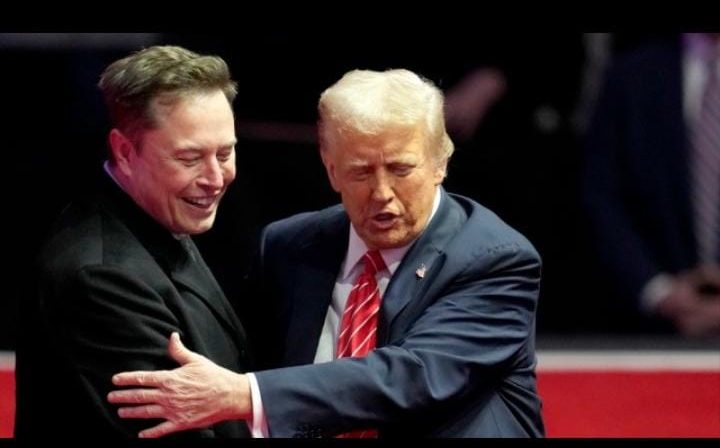
Despite former President Donald Trump’s repeated public claims that billionaire Elon Musk is involved with DOGE, a newly filed court affidavit from the White House contradicts his assertion that Musk serves as a senior advisor to the President. Image: NPR.
Despite repeated public assertions by former President Donald Trump that DOGE is headed by billionaire Elon Musk, a recently filed White House court affidavit refutes that. Musk is neither the administrator nor an official DOGE employee, Office of Administration Director Joshua Fischer says. Instead, he is a senior adviser to the president in a non-career special government employee status.
Trump first publicly declared Musk’s involvement in December 2024, tweeting, “I am happy to announce that the Great Elon Musk, hand-in-hand with American Patriot Vivek Ramaswamy, will be heading up the Department of Government Efficiency.” When Ramaswamy resigned, Trump publicly still referred to Musk as the head of DOGE, but on the affidavit of Fischer, this was similar to the earlier White House aides, such as President Joe Biden’s Anita Dunn.
“In his role as senior advisor to the President, Mr. Musk has no higher authority than do other senior White House advisors. Like other senior White House advisors, Mr. Musk has no formal or practical authority to make government decisions,” the affidavit states.
The affidavit was submitted in response to a legal challenge calling into question the operations of DOGE and control by Musk of the department. During a court hearing, U.S. District Judge Tanya Chutkan expressed concern over the agency’s seemingly erratic nature.
According to Chutkan, DOGE does not seem to be moving in a systematic or predictable way. “This is essentially a private citizen directing an agency that is not a federal agency to have access to the entire operation of the federal government, hiring and firing, cutting, contracting out, terminating programs, all without seemingly any congressional input,” Chutkan said.
Adding to the uncertainty, a Feb. 14 decision by U.S. District Judge John Bates deemed DOEG an “agency” of federal law despite efforts by the Trump administration to avoid that characterisation. “This is apparently from an effort to reap the benefits without its burdens of agencyhood—such as subject to the Freedom of Information Act, the Privacy Act, and the Administrative Procedures Act—without getting only their benefits,” Bates wrote.
In the face of increasing legal scrutiny, the lawyers for the Trump administration have been unable to shed light on DOGE’s governance. During a recent court hearing on DOGE’s eligibility for Treasury Department payment systems, Christopher Healy, the Treasury Department’s general counsel senior adviser, conceded, “I don’t know the answer to that,” when questioned about who controls DOGE.
As DOGE continues to pursue its militant mission to eradicate inefficiencies of the government, the lack of an established leadership structure gives rise to severe legal and moral consequences. Whether or not the courts will require the administration to legitimise DOGE’s mandate—or whether Musk will remain an ad hoc leader in unofficial roles—is still up in the air.
About the Author