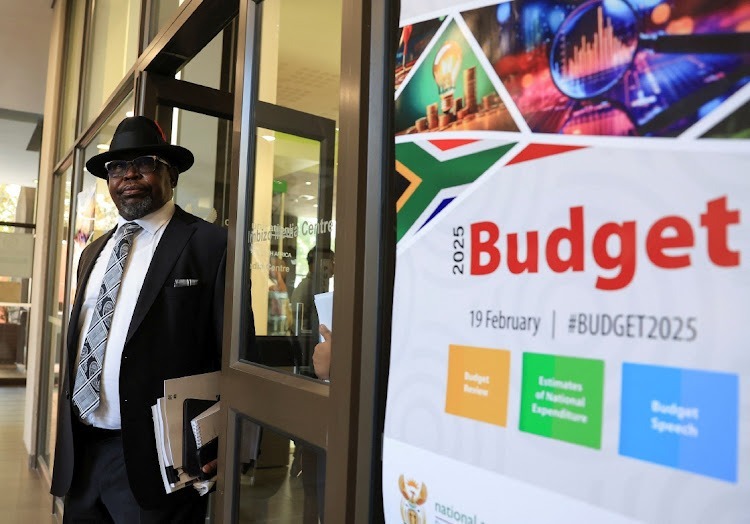
South Africa's Finance Minister Enoch Godongwana leaves after a press conference ahead of his 2025 budget speech in Cape Town, South Africa, February 19, 2025. Image: Esa Alexander
(The Post News)- The dynamics inside the nation’s ruling coalition government have come to light as a result of the recent delays in the release of South Africa’s national budget. In a recent interview with ENCA, political analyst Professor Susan Booysen talked about the ramifications of these developments and the future of the ruling African National Congress (ANC) and its coalition partners.
Disagreements between government parties caused the budget address, which was originally scheduled for February, to be moved to March 12. Some perceived the delay as an inevitable “growing pain,” while others saw it as an indication of instability. According to Professor Booysen, the circumstance underscored a pivotal moment for the African National Congress (ANC), as it now has to deal with the difficulties of a multi-party coalition.
The political analyst emphasised that the ANC’s leadership was forced to recognise the need for more collaborative and genuine engagement within the government. “The fact that the budget was not presented last week was a major concession,” Booysen stated. “It’s a significant moment that reflects how the ANC is acknowledging its missteps in handling coalition politics.”
She noted that President Cyril Ramaphosa, in a recent newsletter, subtly acknowledged the government’s failure to engage adequately with its coalition partners. “The letter from the president suggested a shift in tone, acknowledging that the ANC cannot impose its will on the other parties in the coalition,” Booysen explained. “It seemed like an apology for the approach taken thus far, and this recognition is important for moving forward.”
The delay, according to Booysen, has given the government an opportunity to better align its policies with the broader coalition. The ANC’s prior stance, she said, which centered on implementing its election manifesto without significant consultation, is now evolving. With all coalition parties having a voice, the emphasis is moving toward a more inclusive strategy.
Booysen sees potential benefits in the fiscal situation despite the tension. As the parties resolve their disagreements, she thinks that these growing pains may result in a more stable and cooperative government. “If handled properly, the delay could help establish a more sound budget with greater consensus on its implementation,” Booysen said.
The matter is still controversial, though. Conflict erupted earlier this week when a contentious proposal to raise the Value Added Tax (VAT) was made at the last minute. Opposition parties were incensed that the ANC had advanced the policy without enough engagement.
Minister Godongwana’s subsequent media briefing confirmed that the VAT increase had been introduced unexpectedly, and he admitted that the government had anticipated opposition from its partners.
Booysen argued that the late introduction of the VAT proposal indicated a lack of trust within the coalition. “The fact that it was sprung at the last minute shows how fragile the relationships within the coalition are,” she said. “There seems to be a deliberate effort to push through policies without proper buy-in from all parties, and that risks undermining the stability of the government.”
She identified a major barrier to effective governance as the growing mistrust among coalition partners. The opposition parties have been outspoken in their opposition to the proposed budget, especially the Democratic Alliance (DA). Although there is opposition from smaller coalition parties as well, Booysen pointed out that the DA’s resistance has taken center stage.
“For the government to move forward effectively, all parties must be willing to compromise and recognize that this is a government of national unity, not just the ANC’s government,” she said.
About the Author