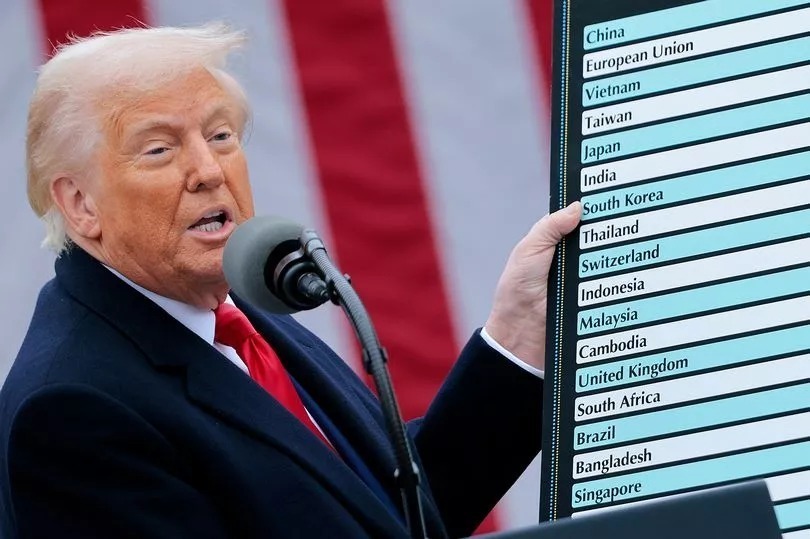
US President Donald Trump holds a reciprocal tariffs poster during a tariff announcement in the Rose Garden of the White House in Washington, DC, US, on Wednesday, 2 April, 2025. Getty Images
(The Post News)- On April 2, 2025, U.S. President Donald Trump launched a comprehensive tariff policy intended at resetting America’s trade agreements with more than 60 countries. This was a stunning action that is likely to have far-reaching effects for global trade. The plan, dubbed “Liberation Day,” imposes a substantial 30% tariff on South African exports to the United States. This decision has sparked worries about economic instability in South Africa and the larger African trade environment.
Trump’s declaration, delivered from the White House Rose Garden, was presented as a daring move to address what he called a lengthy history of foreign nations “looting, pillaging, and plundering” the United States. The president’s rhetoric, which claimed that the new tariff regime would stimulate a revival of American industry, reflected his continued belief that tariffs are necessary to restore the economic strength of the United States.
“We are going to make America wealthy again,” Trump declared, addressing the assembled crowd of cabinet members and industry workers. The reciprocal tariffs, he said, would force foreign countries to treat U.S. exports more fairly. This approach calculates each country’s tariff rate based on how much they charge the U.S. on American goods, with South Africa facing one of the highest tariff rates of 30%. Trump mentioned South Africa specifically, stating that “bad things are going on” in the country.
This new tax poses a serious threat to the South African economy, especially to industries that depend significantly on exports to the United States, such manufacturing and agriculture. Under the African Growth and Opportunity Act (AGOA), which permitted duty-free entry to the U.S. market for specific items, the United States had previously granted preferential access to African countries. Under Trump’s new strategy, South Africa, which has strong export ties to the United States, might lose important trade benefits, endangering jobs and economic expansion.
Trade between South Africa and the United States is substantial, and sectors like citrus farming and auto manufacture are especially vulnerable. These tariffs will make industries like auto manufacturing, which exports more than $2 billion to the U.S. alone, less competitive. The nation’s exports to the U.S. are worth billions of dollars. In sectors of the economy that have previously profited from AGOA’s preferential treatment, this can result in employment losses.
According to economic commentators, the tariffs will put a pressure on South Africa’s economy and may trigger retaliation from other trading partners, which might turn into a worldwide trade war. Parks Tau, South Africa’s trade minister, has urged immediate talks with American officials to lessen the impact, especially for sectors like textiles and the automobile industry that might incur crippling new expenses.
Trump’s proposal also calls for a 10% baseline tariff on imports from all nations and a uniform 25% levy on all cars manufactured abroad. Since Apple and Eli Lilly have already announced large investments in U.S. production, the White House has defended the universal tariffs by claiming that they will increase manufacturing in the country.
Critics caution that these tariffs might have the opposite effect, increasing prices for American consumers and upsetting international supply systems. Economic repercussions could affect many industries, especially those where the United States depends on imports for essential parts. Economists are concerned that the new tariff regime, which Trump’s administration says would help rebalance trade, could result in higher prices for American consumers and ultimately cause the economy to slow down.
About the Author