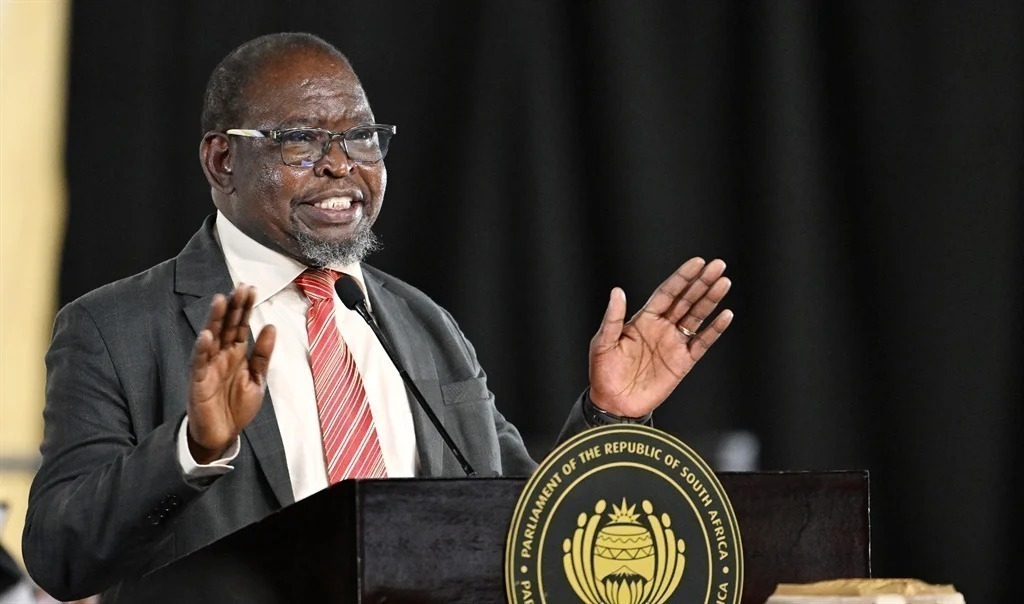
Finance Minister Enoch Godongwana says VAT increase has been blocked for now in order to give Treasury time to rework the numbers and submit a revised fiscal framework to Parliament, photo: Phando Jikelo/SA Parliament
The national budget was approved by the South African parliament on April 2, 2025, in spite of strong opposition and divisions within the coalition. A proposal to raise the Value Added Tax (VAT) by 0.5 percentage points for the upcoming two fiscal years was at the center of the discussion. The inclusion of a 30-day deadline to discover other revenue sources has brought attention to Action SA, a crucial actor in the budget’s passing, even though the vote passed with 194 in favor and 182 against.
It was far from easy to pass the national budget. The Democratic Alliance (DA), a coalition partner of the incumbent African National Congress (ANC), opposed the fiscal framework, as did smaller parties like the Economic Freedom Fighters (EFF). The multi-party government’s future is in jeopardy since the DA voted against the budget.
Action SA, a smaller but significant party outside the Government of National Unity, was crucial in the face of these difficulties. In return for a pledge to eliminate the projected one percentage-point VAT increase, the party supported the ANC’s budget. According to this agreement, the ANC has 30 days to identify alternate ways to generate the required funds. Now, the question is whether Action SA’s faith in the process will be rewarded and whether the ANC and its partners can reach this deadline.
The key concern lies in the legality and practicality of this 30-day concession. According to Dr. Nombeko Mbava, chairperson of the Financial Fiscal Commission, the deadline does not legally bind the ANC to present alternatives within 30 days. “What’s crucial here is that the committee can make recommendations, but the final decision lies with the executive,” she explained. Enoch Godongwana, the minister of finance, is free to suggest several approaches thanks to this flexibility; nonetheless, he is not legally obligated to provide a report with concrete recommendations.
Even while there is no legal requirement, the ANC and its coalition partners are under increasing pressure to fulfill their commitment. Despite the VAT hike, Action SA supported the budget with the explicit expectation that the revenue shortfall from the canceled VAT increase would be filled without placing additional strain on taxpayers. Although the specifics of these measures are still unknown, the ANC has previously stated that it will investigate improved tax compliance, public spending changes, and other economic reforms. Further political wrangling could result if the ANC is unable to offer workable alternatives, particularly if the DA, which has already threatened to file a lawsuit over procedural errors in the budget’s approval, continues to push for more significant fiscal reforms.
The pressure is much greater given South Africa’s precarious economic situation. The yields on government bonds have increased, and the rand has recently lost value in relation to the dollar. These economic data suggest that investors are becoming increasingly concerned about the stability of the nation’s budgetary policies, especially since coalition conflicts jeopardize the unity needed to uphold the government’s objective. Many South Africans have responded favorably to the party’s emphasis on fiscal restraint, but it is still unclear if the ANC can carry out its pledge without raising VAT.
About the Author