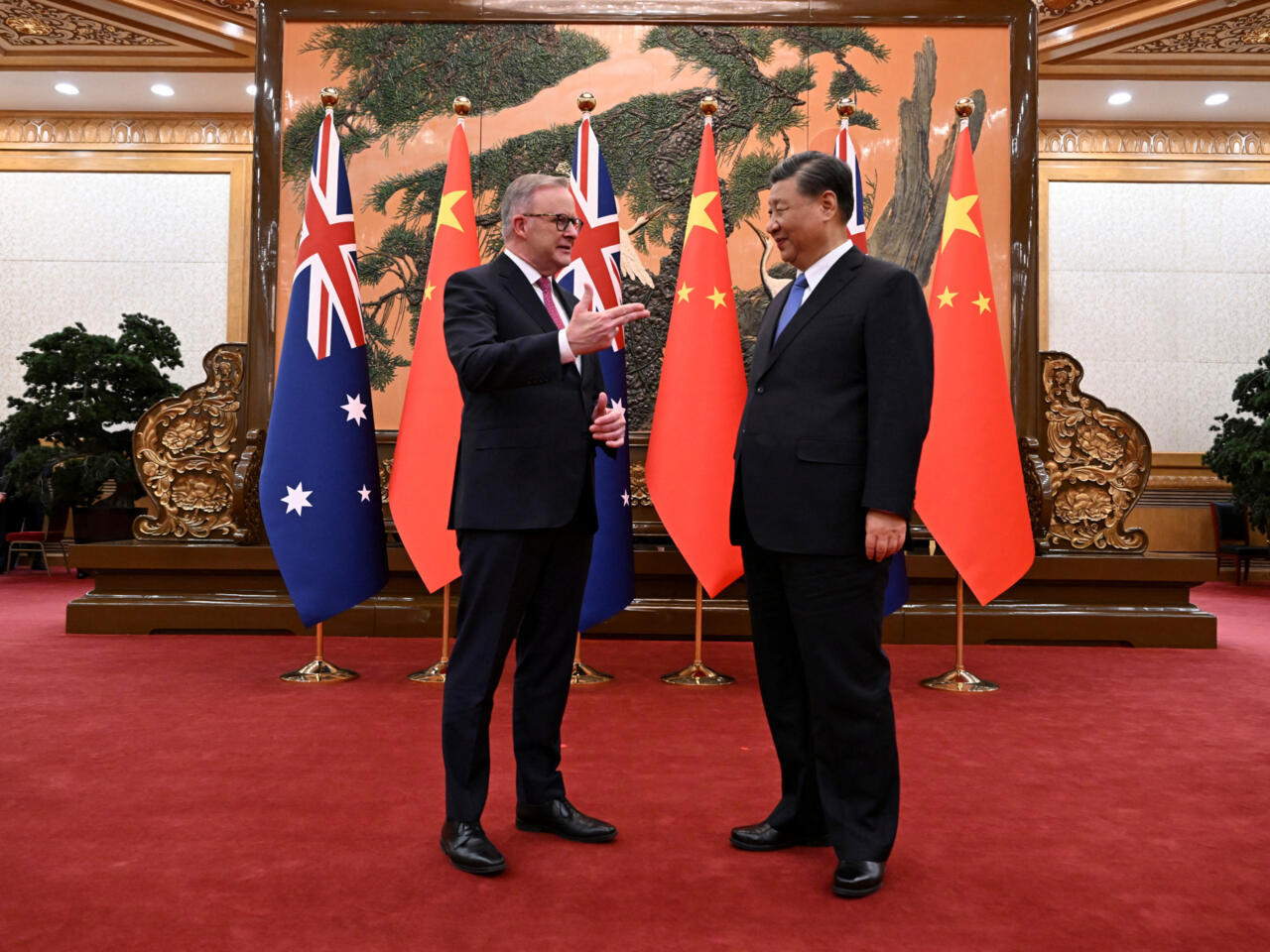
Albanese Meets Xi in Beijing to Strengthen China-Australia Ties Amid Global Tensions. Image: France24.
(The Post News)– Australian Prime Minister Anthony Albanese met with Chinese President Xi Jinping in Beijing on Tuesday, marking the end of a six-day diplomatic visit aimed at resetting bilateral relations and deepening economic connections in the midst of increasing global uncertainty.
In a closely choreographed meeting at the Great Hall of the People, Xi urged the two nations to “unswervingly” proceed with cooperation in the midst of ongoing geopolitical turmoil and rising U.S.-China rivalry. The two leaders highlighted common interest and mutual benefit without explicitly naming publicly the United States or the aggressive trade policy of his predecessor, Donald Trump.
No matter how the international environment may evolve, we must resolutely hold on to this overall orientation,” Xi said in his own words, stressing that there should be dialogue and stability between Canberra and Beijing. Albanese responded warmly and added that the shared approach of “seeking common ground while sharing differences” had brought “very positive benefits to both Australia and China.”
The top-level discussions were Albanese’s second face-to-face meeting with Xi and came after decades of strained relations, which were partly instigated by Canberra’s call for a COVID-19 origins inquiry and which led to $20 billion worth of Chinese sanctions on Australian trade. Albanese has since taking office focused on repairing those relations, balancing Australia’s economic reliance on China against its security alliance with the United States.
While trade was the centerpiece of Albanese’s visit, with each side marking the resurgence in economic ties, security matters lingered. The prime minister confirmed to have brought up with Xi fears over a Chinese naval live-fire exercise earlier this year off New South Wales, informing him that the exercise was legal under international law but the timing and the manner of the exercise were of concern.
The two nations agreed on the areas of tourism, agriculture, customs clearance, and the new Policy Dialogue on Steel Decarbonization, a gesture of openness for greater cooperation, even though no new big trade deals were announced. Albanese indicated Australia would continue its policy of “cooperate where we can, disagree where we must,” but indicated the trade relationship with China would be kept separate from its alignment with the United States.
“Our relationship with China is very different from that,” he said to reporters, in reference to Trump’s trade tariffs and rising pressure from Washington on Taiwan. Against this background, Albanese made his trip. There has been rising tension in the Indo-Pacific, most notably about Taiwan. In a recent Financial Times report, it was discovered that the U.S. Pentagon is encouraging allies like Australia and Japan to establish their stance if conflict were to arise over the self-ruled island.
Albanese maintained Australia’s long-standing support for the “status quo” in Taiwan, without making a commitment to military involvement. “Dialogue is the way we advance our interests, how we manage our differences, and how we avoid misunderstanding,” he said. Coalition Senator James Paterson defended the government’s stance, pointing out that even the US had maintained strategic ambiguity since the Taiwan Relations Act was enacted in 1979. “The U.S. hasn’t gone to war over Taiwan, and neither should we,” he told ABC radio.
While primarily concerned with diplomacy and trade, the trip was not without tension. Albanese brought up the case of Chinese-Australian author Yang Hengjun, who is under a suspended death sentence on charges of espionage. While he did not anticipate an immediate resolution, Albanese stressed the value of “patient, calibrated advocacy.”
Another episode in which Chinese security officials attempted to stop Australian journalists from recording at a Beijing tourist attraction also left eyebrows raised. Albanese did accept the incident, saying, “China has a different system, obviously, with the media,” while reiterating his commitment to a free press.
Field reporters, including ABC’s Stephen Dziedzic, reported that they were halted by a number of guards and asked to turn over footage, despite having clearance to film. Australian embassy officials intervened, and crews were finally cleared to depart without incident.
Albanese’s visit underscores the delicate diplomatic balancing act Australia must perform between its most important trading partner and its top security ally. Xi, in turn, used the meeting to diplomatically underscore China’s role as an advocate of multilateralism and free trade—a not-so-subtle rebuke of tariffs and American protectionism under Trump. “Under such circumstances, China and Australia, as major trade partners, should enhance mutual dialogue and cooperation,” Xi stated.
Although the enhanced tone and fresh diplomatic style are appreciated, experts warn that the deepening economic relationship comes with a strategic price. “Albanese is banking on economic pragmatism, but the vulnerability of Australia’s over-reliance on China remains,” Strategic Analysis Australia director Michael Shoebridge told AFP. “Greed is beating strategic caution.”
Still, both sides appear intent on keeping communication lines open. Albanese’s three-city, six-day tour to Shanghai and Beijing did not produce colossal deals, but it was an important move toward stability in a shaky era of international relations. “This is not the end of a process; it’s a continuation,” Albanese told reporters. “We have to keep talking. That’s how we avoid miscalculation and maintain our region’s security.”
About the Author