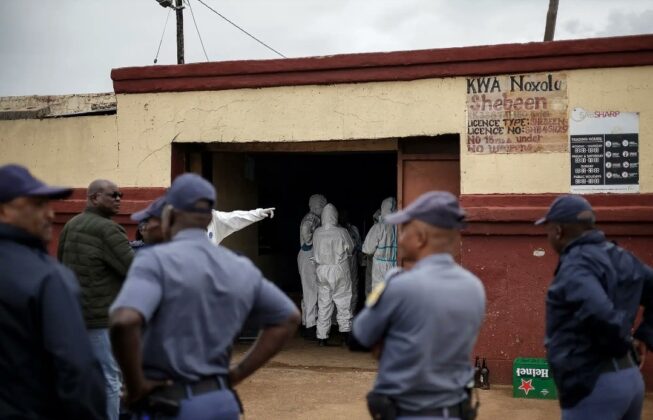
Urgent Call for Parental Responsibility rise following Glenover Secondary School racial violence. Image: Supplied Via KZN Education News.
(The Post News)– Glenover Secondary School racial violence erupted on Friday, 29 August, shocking the KwaZulu-Natal community and reigniting debates about race, discipline, and parental responsibility in South African schools.
What began as a minor soccer field disagreement quickly escalated into racially charged attacks, not only involving learners but also parents and former learners who actively contributed to the chaos. The KwaZulu-Natal Department of Education strongly condemned the incident, calling it “deeply disheartening” and “unacceptable.”
At least five learners were stabbed during the attack—four African and one Indian learner. Police investigations are ongoing, and the department has appealed to parents and the broader community to cooperate in restoring peace and preventing further violence.
From a Minor Alteration to a Serious Racial Incident
A soccer field disagreement between two Glenover learners escalated into something far more dangerous. Initially, the school acted decisively by suspending the four learners directly involved to prevent further conflict.
However, later that day, a group of outsiders—including a parent and former learners—entered the school premises armed with knives. In this violent confrontation, five learners were stabbed. Fortunately, none of the injuries were life-threatening, but the psychological impact on the learners and the community was severe.
Department of Education Strongly Condemned the Glenover Incident
The KwaZulu-Natal school racial conflict prompted immediate action from the provincial Department of Education. Officials expressed grave concern over the involvement of adults, stressing that schools should remain safe spaces for learning. “We are gravely concerned that this violence was racially motivated and aggravated by adults who should be setting an example of tolerance, peace, and restraint,” the statement read.
Muzi Mahlambi, spokesperson for the KZN Department of Education, said, “Education in Guazindan is disturbed by what happened at Glenover Secondary School. A minor altercation escalated into a racial conflict. We commend the school for handling the situation well, but we are investigating and meeting with the school governing body and community to eradicate these ugly incidents.”
The Role of Parents
A key takeaway from the incident is the role of parental responsibility. The department emphasized that schools can only do so much to instill values of respect, tolerance, and non-violence; foundational discipline starts at home. “We remind our communities that discipline begins at home. Parents play a critical role in instilling values of respect, tolerance, and non-violence. The school’s mandate is to educate, not to constantly correct behavior that reflects poor guidance at home.”
Education MEC Offers Support to School Officials
KwaZulu-Natal MEC for Education, Mr. Sipho Hlomuka, condemned the criminal behavior of community members and reaffirmed support for school authorities. “We will stand firmly with the principal, management team, SGB, and SAPS to ensure that this racial conflict is swiftly resolved and that schools remain safe spaces for teaching and learning.”
Learners: Innocent Victims of Violence
For learners at Glenover Secondary School, the violence was more than an incident; it was a violation of their right to safety. Students preparing for Grade 12 trial exams and term assessments for Grades 8 to 11 now face heightened anxiety and trauma.
The five learners who were physically attacked must recover from both physical and psychological harm. The incident shows how adult failures can endanger the very children schools are mandated to protect.
Racial Tensions in South African Schools
The Glenover Secondary School racial violence incident reflects broader racial and socio-economic divides in South African schools. Despite policies promoting non-racialism and inclusivity, schools sometimes mirror community prejudices.
Incidents such as racial slurs, sports-related clashes, and parental interference are reminders that integration remains fragile. Schools cannot resolve these issues in isolation; community engagement is essential to fostering a safe and inclusive learning environment.
Social Media’s Role in Escalation
Social media amplified the Glenover incident. Videos and photos circulated widely, often stripped of context and paired with inflammatory commentary. While social media can highlight injustices, it can also worsen tensions. The Department has cautioned learners and parents about responsible online behavior, stressing that reckless posts may interfere with investigations and inflame already volatile situations.
Calls for Healing and Unity
Community leaders, religious organizations, and civil society groups have called for calm and constructive dialogue. Faith-based initiatives are encouraging assemblies that include parents, learners, and educators to promote understanding and mutual respect.
The Glenover Secondary School racial violence incident is a reminder of how quickly minor disputes can escalate when external factors, including adult interference, are involved. While the Department of Education’s condemnation is necessary, long-term solutions require parental responsibility, community cooperation, and strong school safeguards.
As teaching resumes, Glenover Secondary stands at a crossroads. The school community must decide whether division will define it or whether collaboration, tolerance, and education will prevail. The future of learners depends on the collective commitment to peace and safety.
About the Author