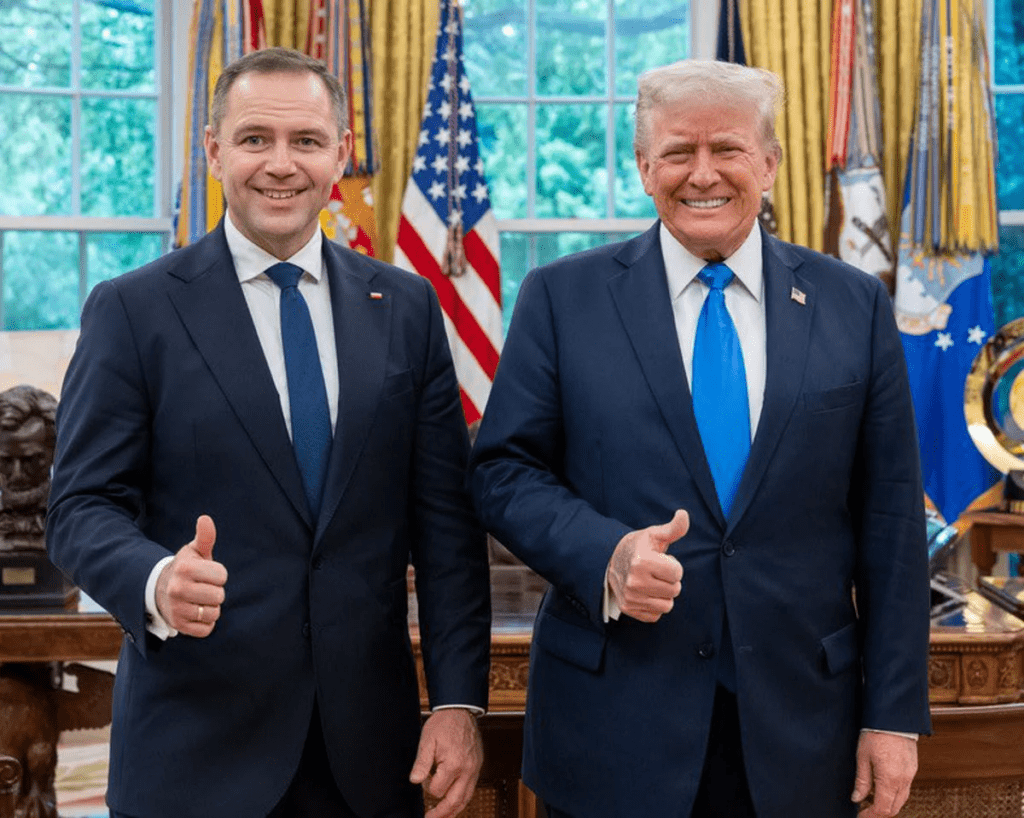
President Karol Nawrocki to meet U.S. President Donald Trump for the second time, seeking to strengthen military ties and address European security concerns [Image by Lexington Institute]
(The Post News) – Polish President Karol Nawrocki will sit down with U.S. President Donald Trump this Wednesday in a highly anticipated first foreign visit since his inauguration a month ago. Nawrocki will be seeking to strengthen the relationship with the U.S. and back the current strong military presence of U.S. soldiers in Poland amid increased tensions across Europe.
Nawrocki, a Law and Justice party nationalist and former amateur boxer, becomes president with the support of Trump after elections in the spring in Poland. The trip is a big diplomatic move by Poland’s new leader to consolidate ties with a critical ally amid rising geopolitical tensions.
Stalled Peace Efforts
The session is at a stage where Trump is exasperated that he cannot bring Russian President Vladimir Putin and President of Ukraine Volodymyr Zelenskyy to the negotiating table to negotiate an end to the violence that has been ongoing for over three years. Trump had talked to both the leaders separately and was hopeful previously of having them sit at the negotiating table, which has since dissipated with Putin not being willing to compromise.
Trump spoke about the war in a recent interview, saying that more conflict is perhaps unavoidable, telling journalists, “Maybe they have to fight a little longer. just keep fighting, stupidly, keep fighting.”
The setting for this round of negotiations is rising concern in Poland and broader Europe that Trump is not fully committed to a robust U.S. military presence on the continent, a sure deterrent against any future Russian aggression. Top Trump advisers have discussed the possibility of diverting U.S. military assets from Europe into the Indo-Pacific, where China is seen as the leading strategic competitor. Up to 10,000 American troops are stationed in Poland on a rotational basis.
Nawrocki – Trump Stakes of The Meeting
Peter Doran, a Foundation for the Defense of Democracies researcher, said of the significance of the visit by Nawrocki: “The stakes are very high. Failure in this meeting could lead to the withdrawal of American troops from Poland, but success can cement Poland as a key partner on the front line of deterring Russian aggression.”.
Prior to Nawrocki’s election victory, Trump had already indicated his affection for the nationalist candidate and predicted warmer military ties in the event he was voted into power. The Secretary of Homeland Security, Kristi Noem, also visited Poland prior to elections, assuring voters that electing Nawrocki would provide them with a strong ally in Trump, who would protect Poland from its adversaries.
Nawrocki has echoed Trump’s policy towards Ukraine during his time in office, vowing to support Kyiv but also condemning Zelenskyy and accusing certain Ukrainian officials of taking advantage of the good will of allies. He groused about Ukrainian refugees being given access to Polish resources and vowed to give priority to Polish citizens in terms of social services.
While tensions between geopolitics grow stronger, Nawrocki will most assuredly present to Trump the danger of Russia’s belligerent posturing, with a focus on an extended U.S. military presence in Poland. Russia’s upcoming combined military exercises with Belarus contributed to the already strained atmosphere in Eastern Europe.
Heather Conley, a senior nonresident fellow at the American Enterprise Institute, described the message Nawrocki communicated to Trump: “The endgame here is to bring attention to the danger of Putin’s ambitions and to make the case that this type of revisionism is not going to stop in Ukraine.”
As the two leaders proceed to sit down and converse, their meeting is anticipated by analysts to discuss the stalled war peace negotiations, Poland’s security concerns, and broader implications for NATO at a moment of shifting dynamics in international relations.
About the Author