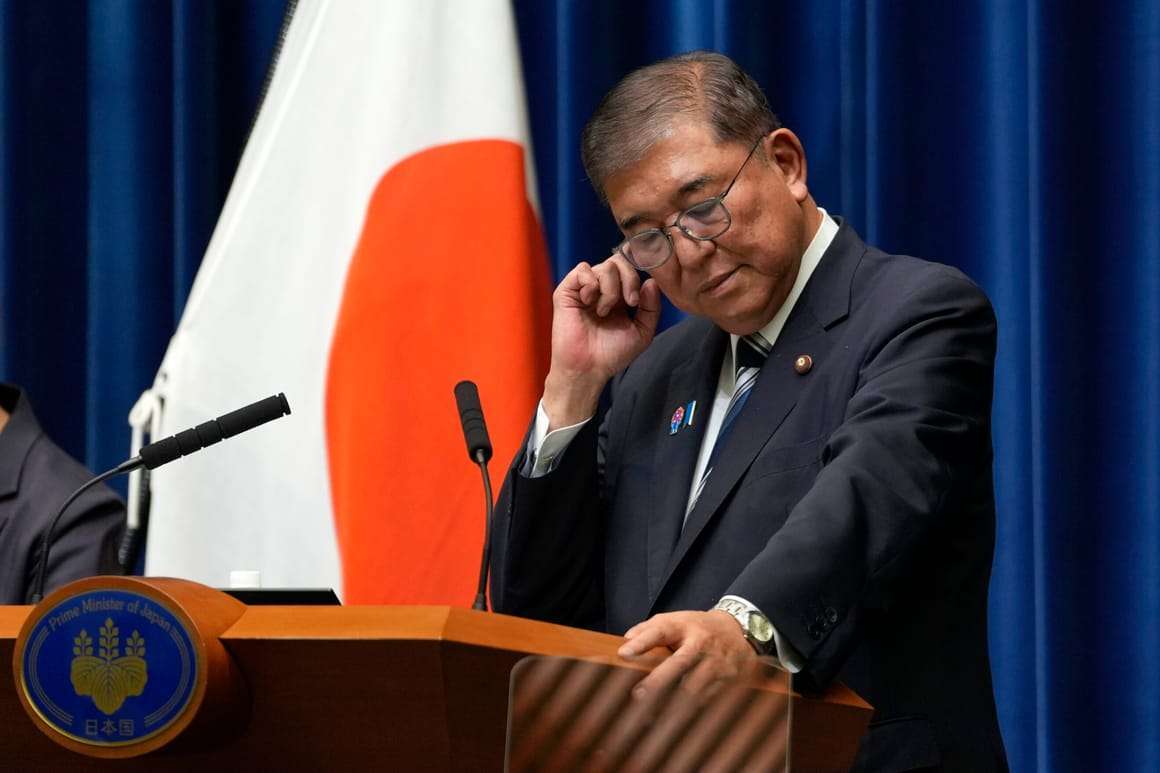
Prime Minister Shigeru Ishiba resigns after less than a year in office, leaving Japan's ruling LDP divided and sparking a high-stakes leadership battle. Image: Politico.
(The Post News)– Japan is thrown into a political crisis after the resignation of Prime Minister Shigeru Ishiba just nine months after he was sworn in. The 68-year-old centrist head of Japan’s ruling Liberal Democratic Party (LDP) quit on Sunday evening after two embarrassing election losses handed the party and its coalition partner, Komeito, their majorities in parliament.
He announced this on the eve of an attempt by his internal rivals to bring forward an early party leadership election, a maneuver that would have been a no-confidence vote. Ishiba said that he resigned voluntarily so that he would not force a painful split in the party.
I have decided to step aside to make way for the next generation,” Ishiba told a press conference. “Now that US tariff talks are over, I believe the timing is appropriate.”
LDP’s Election Losses Spark Crisis
Ishiba’s resignation is the result of two historic election losses. In October 2024, just a month after he had taken office as prime minister, the LDP-Komeito coalition lost the majority in the House of Representatives for the first time in 15 years. Later, in July 2025, the same coalition lost its majority in the House of Councillors.
The double defeats rendered Japan’s most powerful political coalition incapable of governing without the help of opposition parties. Members of the LDP, especially its conservative factions, blamed Ishiba for the defeats and alleged that he had failed to inspire the party’s traditional constituents.
A survey conducted by Kyodo News released Sunday showed Ishiba’s approval rating dropping to 32.7%, the lowest since he took office as prime minister. Analysts said frustration at rising living costs, particularly skyrocketing rice prices, eroded public support and stoked discontent in the ranks of the ruling Liberal Democratic Party.
Until last week, Ishiba resisted calls for resignation, insisting that his priority remained the closure of the trade negotiations with the United States. On Friday, US President Donald Trump ordered a cut in US tariffs on Japanese automobile imports, reducing rates from 27.5% to 15%. Tokyo welcomed the agreement as an unusual breakthrough in bilateral trade tensions.
“Who in their right mind would seriously negotiate with a government whose prime minister says he is resigning?” Ishiba asked. “Having reached a milestone in the U.S. tariff negotiations, I decided now is the time to hand over to a successor.” The agreement brought temporary relief to Japan’s faltering export sector, but it was not enough to salvage Ishiba’s premiership.
Leadership Battle Ahead
With Ishiba declaring he will not be contesting the next election, all eyes are now on who will lead the LDP and, hence, Japan’s next prime minister. Several candidates already have their names floated as possible frontrunners, including Sanae Takaichi, the hardline ex-economic security minister, who lost last year’s leadership vote to Ishiba by a hair. She would be Japan’s first female prime minister if elected. Shinjiro Koizumi: Handsome and young farm minister and son of former Prime Minister Junichiro Koizumi. The darling among youth voters, Koizumi recently made headlines with his talk on agricultural reform and previously, for mentioning the climate crisis as “sexy and fun.” Yoshimasa Hayashi: Current Chief Cabinet Secretary and protégé of former Prime Minister Fumio Kishida, representing a more centrist and diplomatic wing of the party.
The outcome will largely depend upon the role of party heavyweights such as seasoned Prime Minister Taro Aso and parliamentarians close to the assassinated 2022 late Shinzo Abe. Both these groups have been insistent in their resistance against Ishiba and are expected to play the role of kingmaker during the vote.
The presidential election will be conducted in early October, with parliamentarians and regular party members casting ballots to elect the president.
Challenges Await Ishiba’s Successor
Anyone who wins will inherit a country beset with grave problems, such as economic hardship. Double-digit inflation has doubled the price of rice and other essentials, fueling discontent. Party scandal: The LDP still bears the taint of recent finance scandals, undermining public trust. Geopolitical tensions: Rising tensions with China, constant security threats from North Korea, and reliance on Washington for trade security require careful foreign policy management. Domestic politics: With no majority in either house, the administration must negotiate with opposition parties to pass legislation, putting it at risk of motions of no confidence.
Japan’s opposition remains fragmented, so the scope of non-LDP rule in the near term is limited. The increasing appeal of the right-wing populist Sanseitō party, however, in response to immigration outrage and the cost-of-living crisis, signifies voter disillusionment is on the rise.
Ishiba, long considered a rebel within the LDP, achieved his dream to serve as prime minister after four failed attempts. But his time in office lasted but briefly. “By doing so, I could not go in my own direction, and I do not know how I could have done better,” Ishiba said in his farewell remarks.
Regardless of whether his resignation signals instability in Japanese politics, there are certain voters who see it as an opportunity for renewal. Office worker Takahiro Uchi said, “I am glad that Ishiba resigned because it promises a change. But at the same time, there is uncertainty about who is going to fill the gap.” For Ishiba, his resignation marks a troubled era in Japanese leadership. For his successor, the final test is to provide stability to a country at a political crossroads.
About the Author