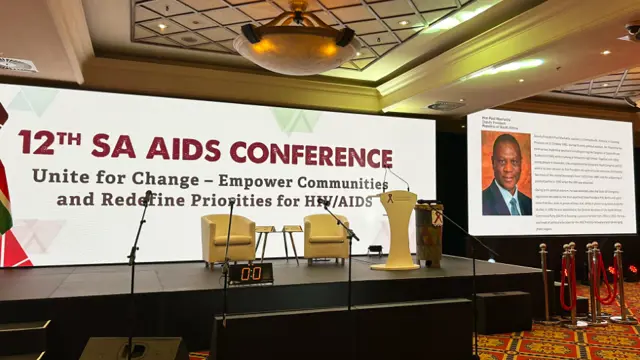
The 12th SA AIDS Conference begun on Monday 08 September 2025 at the Emperors Palace in Ekurhuleni. Image: Jabulile Mbatha/ EWN.
(The Post News)– Deputy President Paul Mashatile called for a stronger, more collaborative approach in the fight against HIV/AIDS, emphasizing that communities most affected by the epidemic must be at the forefront of the response. Speaking at the 12th SA AIDS Conference at Emperors Palace on Monday, Mashatile, in his role as chairperson of the South African National AIDS Council (SANAC), stressed the need to move away from a “top-down, clinic-centered approach.”
The four-day conference, held under the theme “Unite for Change—Empower Communities and Redefine Priorities for HIV/AIDS,” brings together a wide range of stakeholders, including industry leaders, researchers, academics, and government officials. The goal is to discuss and refine strategies to manage HIV/AIDS, tuberculosis (TB), and other sexually transmitted infections (STIs).
“To empower communities and redefine priorities for HIV/AIDS, our strategies must prioritize giving power and resources to those who are most affected,” Mashatile stated. He called for stakeholders to fully leverage the National Strategic Plan for HIV, TB, and STIs (NSP 2023-2028), which promotes universal access to healthcare, greater awareness, and the dismantling of stigma.
Mashatile on Navigating Funding Challenges
Mashatile also addressed the critical issue of funding, particularly in light of recent cuts to foreign aid from the United States, including from the President’s Emergency Plan for AIDS Relief (PEPFAR). This program has long supported nonprofits in South Africa that assist with HIV testing and treatment. “As government, we acknowledge the impact of US funding cuts on our response; even so, the government is diligently working to preserve our achievements in the fight against HIV/AIDS,” he said.
Mashatile announced that the government is focusing on increasing domestic funding, launching national campaigns, and exploring new partnerships with BRICS nations and the private sector to fill the financial gaps.
Progress and Remaining Hurdles
While acknowledging the significant progress made, Mashatile highlighted the challenges the country still faces in meeting the Joint United Nations Programme on HIV/AIDS (UNAIDS) 95-95-95 targets. These ambitious goals aim for 95% of people with HIV to know their status, 95% of those to be on treatment, and 95% of those on treatment to be virally suppressed.
“The country is currently sitting at 96-78-97,” Mashatile reported, noting that the biggest challenge remains the second “95”—getting and keeping people on sustained antiretroviral treatment. In response, Health Minister Aaron Motsoaledi launched a campaign in February to find 1.1 million people with HIV who are not yet on treatment. This initiative runs parallel to the “End TB Campaign,” which aims to test five million people during 2025/26.
Despite these challenges, Mashatile expressed confidence in the country’s resilience. “We are a resilient country with a brilliant track record in HIV management,” he said. “Together, we can shape a future where HIV/AIDS is no longer a threat but a distant memory of our collective strength and determination.”
About the Author