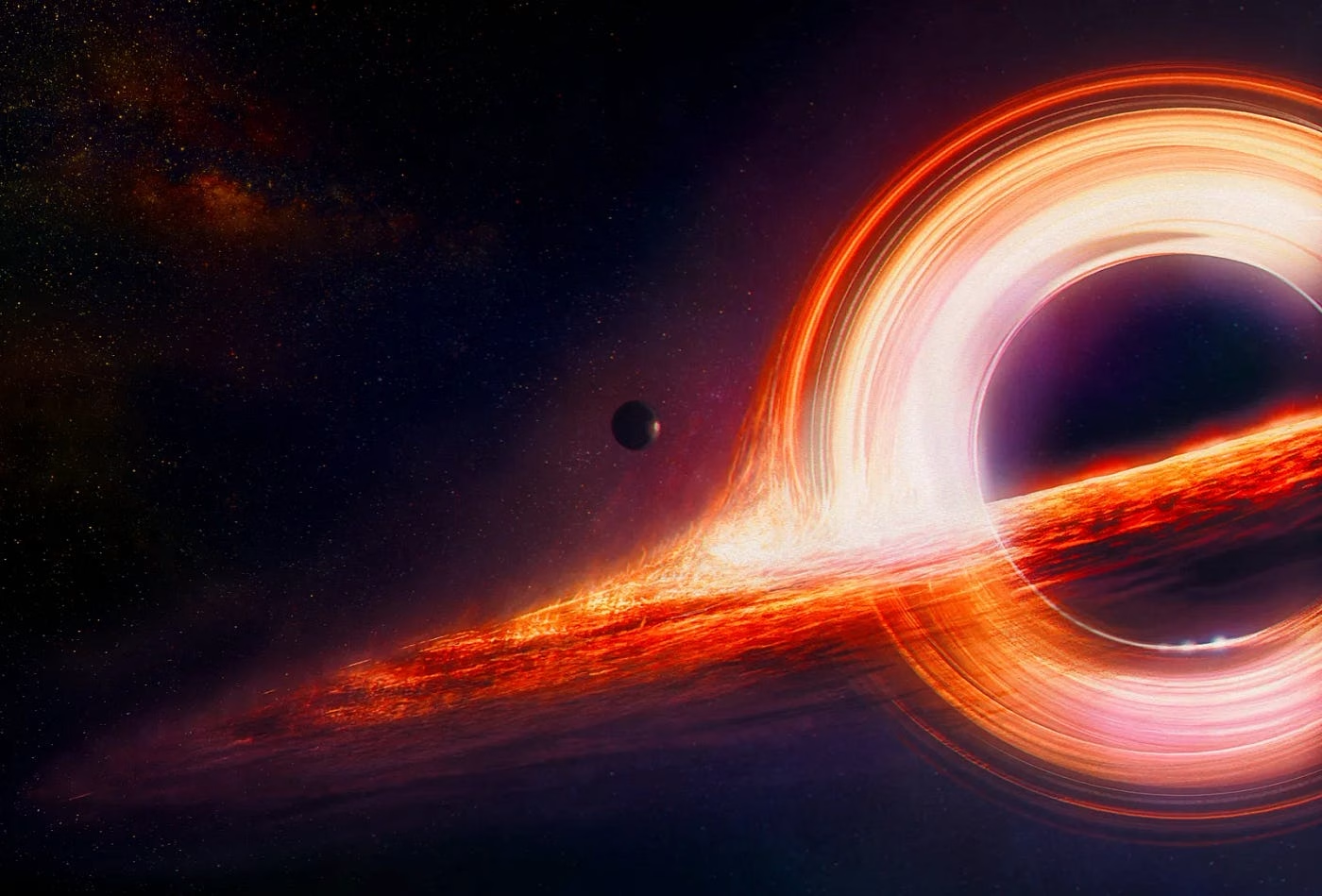
The Laser Interferometer Gravitational Wave Observatory (LIGO) detected the most powerful gravitational waves ever recorded. Image credit: Medium
(The Post News) – Astronomers have recorded the most accurate black hole merger ever witnessed, confirming key predictions by Albert Einstein and Stephen Hawking and gaining the best glimpse yet into the universe’s extreme physics.
On January 14, 2025, the US-based Laser Interferometer Gravitational-Wave Observatory (LIGO) picked up the loudest gravitational-wave signal on record, now designated GW250114. The waves were created 1.3 billion light-years away, as two massive black holes, one about 34 times the mass of the Sun and the other 32, spiralled towards each other and collided at near the speed of light.
The catastrophic merger combined them into a single black hole with a mass of approximately 63 times that of the Sun and spinning at an incredible 100 revolutions per second. It unleashed energy equivalent to destroying three Sun-sized stars in a fraction of a second.
“This is like hearing the universe ring like a bell,” said Maximiliano Isi, Columbia University astrophysicist and co-lead author of the study in Physical Review Letters. “For the first time, we can read that ringing with sufficient precision to confirm the most basic predictions about black holes.”
Einstein’s “Simple Black Holes” Theory Confirmed
One of the breakthrough discoveries using GW250114 was the confirmation of the Kerr hypothesis, which arose from Einstein’s general theory of relativity and was put forward by New Zealand mathematician Roy Kerr in 1963. It dictates that black holes, as complex as they are, are in fact incredibly simple: they can be described entirely in terms of just two numbers, their mass and their spin.
The LIGO researchers studied the final stage of the merger, known as the ringdown. Just as a bell will produce a characteristic set of tones after being struck, the new black hole rang with characteristic gravitational wave frequencies. By studying these “tones,” researchers concluded that the black hole rang exactly as Einstein’s theory predicts.
This is the strongest evidence to date that black holes are the simplest macroscopic objects in the universe,” said Emanuele Berti, a Johns Hopkins University physicist who was not involved in the work.
Hawking’s Area Law Theorem Validated
The second discovery confirmed Stephen Hawking’s 1971 area law theorem, which predicts that the total surface area of a black hole’s event horizon, the point of no return beyond which nothing escapes, can never diminish.
Before merging, GW250114’s two black holes had a combined surface area of about 240,000 square kilometres. Then the event horizon of the final black hole was about 400,000 square kilometres, verifying Hawking’s prediction with record accuracy.
“Hawking believed this law was as fundamental as the second law of thermodynamics,” Isi said. “Now we have experimental verification from nature itself.”.
Nobel laureate and LIGO co-founder Kip Thorne remembered that Hawking phoned him immediately after the 2015 detection of gravitational waves to ask if his theorem could be tested experimentally. “If Stephen were alive, he would be thrilled,” Thorne said.
The 2025 event marks a milestone in gravitational-wave astronomy, a field only a decade old. When LIGO first detected gravitational waves in 2015, Einstein’s 1915 prediction was finally proven, netting three scientists the Nobel Prize.
LIGO and its European and Japanese counterparts, Virgo and KAGRA, have since recorded more than 300 black hole mergers. GW250114 was a step above the rest, though, in that it gave the clearest signal to date, four times clearer than the first detection, owing to major LIGO upgrades in lasers, mirrors, and noise reduction systems.
This is just the beginning,” said Macarena Lagos, an astrophysicist at Universidad Andrés Bello in Chile. “Future detectors will allow us to probe Einstein’s and Hawking’s theories with even greater precision, and maybe discover cracks that will lead to new physics.”.
Such breakthroughs would help physicists resolve one of the largest issues in physics: reconciling Einstein’s theory of relativity, which describes gravity on a cosmic level, with quantum mechanics, which governs the subatomic world.
The Future of Black Hole Research
The detection of GW250114 demonstrates the incredible strength of modern astronomy. By “listening” to space-time itself, scientists can now study black holes, objects opaque to conventional telescopes, in fine detail.
As LIGO and its partners continue upgrading, astronomers expect to observe more distant and massive collisions, possibly including neutron star, black hole mergers and even rarer cosmic events.
“Every new detection is a step closer to a complete understanding of gravity,” Isi said. “We’re not just proving Einstein and Hawking right, we’re pushing physics into uncharted territory.”
About the Author