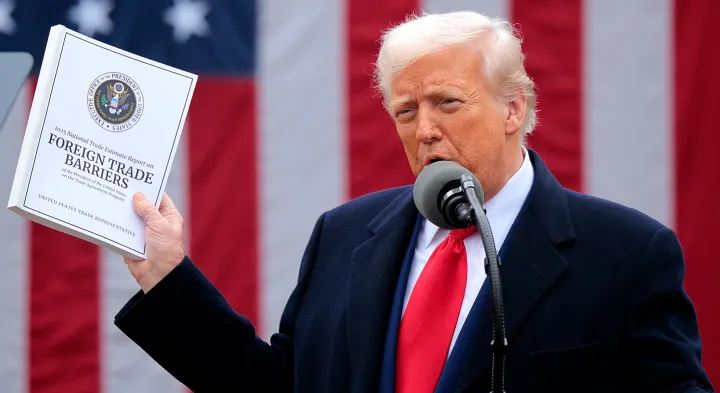
Trump Tariffs Backfire: Emerging Markets Gain Momentum as US Faces Stagflation Risks Image Credit: Daily Maverick
Trump Tariffs: A Double-Edged Sword for the Global Economy
(The Post News) – Trump Tariffs were introduced with the promise of restoring American manufacturing pride and protecting domestic jobs. At the heart of the Trump administration’s argument was the claim that unfair foreign trade practices posed a “national emergency.” However, rather than shielding the US economy, these tariffs have created ripple effects across the global economy and inadvertently empowered emerging markets.
Sangeeth Sewnath, managing director of Americas at Ninety One, speaking at the Morningstar Investment Conference in Cape Town, highlighted that the point of tariffs often lies in either protection or leverage. “At the moment, you will see that it’s a lot more leverage than it is protection,” he said. This has raised concerns about the long-term effects of this policy on global trade and growth.
Emerging Markets Take the Lead
The global economy is shifting as countries like China and India seize new opportunities. China has been quick to capitalize on Trump Tariffs, strengthening its domestic economy and drawing back its brightest scientists and engineers expelled by restrictive US immigration policies. Liang Du, CEO of Prescient Private Fund Management, remarked that “what Trump has done for China, China could not do for itself in decades.”
India, too, is rising as a manufacturing alternative to China. Allan Gray portfolio manager Pieter Koornhof stated that India’s market-opening reforms and low labor costs have positioned it as a key player in the future of global supply chains. “The other important competitive advantage for India is that it isn’t China,” he added.
For South Africa, this emerging market momentum is a chance to attract investors. Michael Dodd, senior fund analyst at Morningstar Investment Management, said that fund managers are more overweight in emerging markets than at any time in the past two years. South Africa’s mining sector, in particular, has benefited, with gold stocks doubling their share of the local index since January.
US Stagflation Risks Rise
The unintended consequence of Trump Tariffs has been the risk of US stagflation – a toxic mix of slowing growth and rising prices. Grant Slade, international economist at Morningstar Investment Management, warned that these policies may trigger a “stagflation-style” scenario in the coming quarters. This would weaken consumer demand and create significant challenges for the US economy.
An internal analysis on US economic growth trends shows that persistent tariffs could put pressure on supply chains, increasing production costs and ultimately hitting consumers
Global Economy at a Turning Point
Since the end of World War II, the US market has dominated global trade, but the tide appears to be shifting. Analysts see 2025 as a turning point, with emerging markets finding their moment to shine. As Dodd observed, this is the highest level of emerging market investment interest seen in years.
This global realignment offers opportunities for businesses to diversify and explore new markets.
Lessons from Trump Tariffs
The Trump Tariffs story serves as a powerful reminder of how interconnected the global economy is. Policies aimed at strengthening one nation can unintentionally empower others. For the US, the risk of stagflation looms large, while emerging markets like China, India, and South Africa are poised to benefit from this economic shift.
Businesses, policymakers, and investors must adapt to this new reality. The key takeaway is that protectionist policies can reshape the global economy in ways that may favor competitors rather than protectors.
About the Author