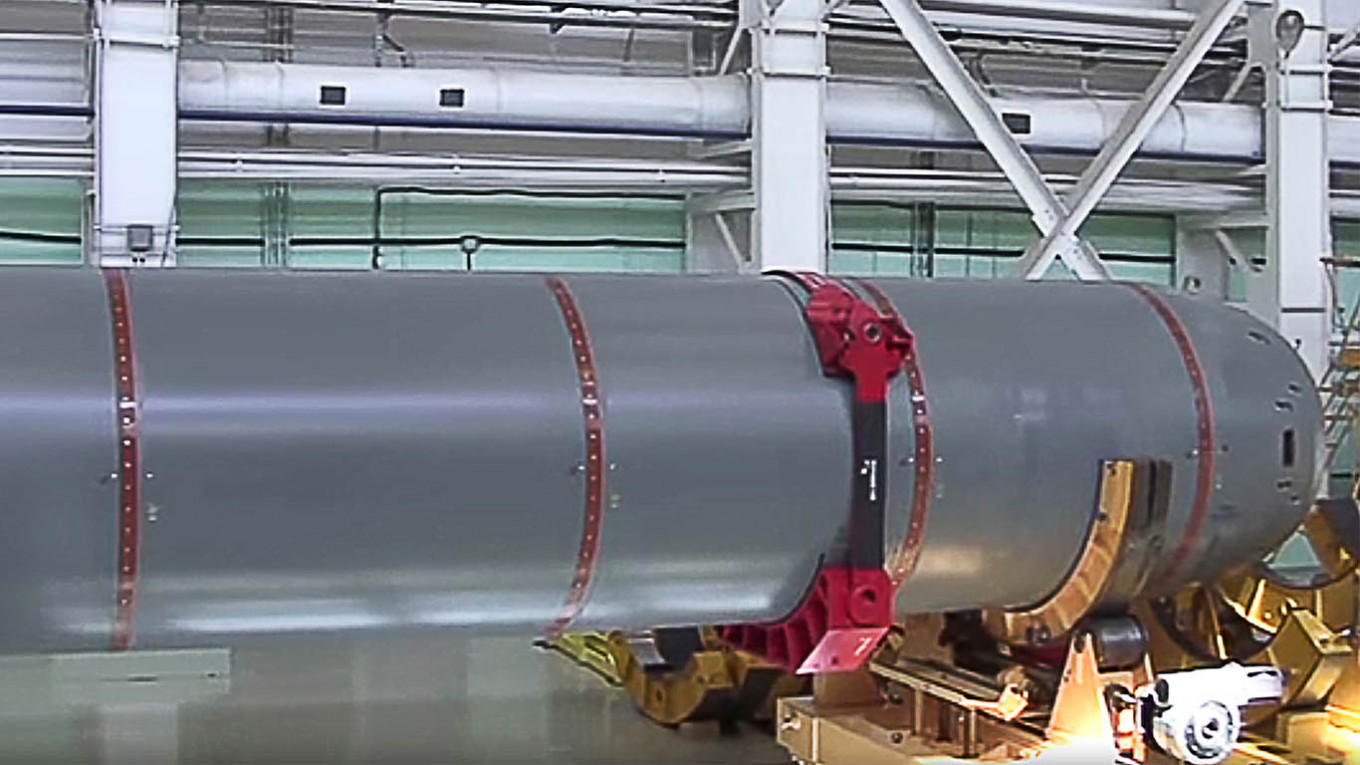
Russian President Vladimir Putin Claims a successful test of the Poseidon nuclear-powered underwater drone, saying the "unstoppable" weapon marks a major advance in Russia's strategic deterrence [Image by The Moscow Times]
(The Post News) – Vladimir Putin announced on Wednesday that Russia had successfully tested its new Poseidon nuclear-powered underwater drone, which he referred to as an “impossible to intercept” weapon. This test constitutes another demonstration of military power in light of growing tensions with the U.S. regarding the war in Ukraine.
Russia Tests “Unstoppable Nuclear Drone”
Speaking to soldiers wounded from the state’s battles in Ukraine, at the Moscow military hospital, Putin asserted that the Poseidon was nuclear-powered for the first time on Tuesday. The trial was termed by him as “a huge success” in what the strongman lauds as another milestone of Russian defence technology.
“There is nothing like this unmanned vehicle anywhere in the world,” said Putin. “In speed and operating depth, it has no equal, and there is no way for interception.”
According to Putin, the compact reactor on board the Poseidon is 100 times smaller than those of submarines but produces a lot more energy. He also claimed that the nuclear warhead of the drone exceeds the might of Russia’s most developed Sarmat intercontinental ballistic missile.
The Poseidon-with NATO’s name “Kanyon” and formerly Status-6-would be approximately 20 meters long, 1.8 meters in diameter, and around 100 tonnes heavy. According to Russian state media, it can attain speeds up to 200 kilometres per hour (124 mph) at a depth greater than any existing torpedo.
With nuclear propulsion granting it virtually unlimited range, Poseidon can travel long distances undetected, which makes locating or destroying it by enemy forces extremely difficult.
Russian defence sources say that Poseidon is a “doomsday weapon” that detonates near coastal cities and an unleashing of a wave of radioactive water that wipes entire naval bases and ports out entirely.
Putin first unveiled Poseidon during his 2018 state-of-the-nation address, along with five other advanced “super weapons” developed so as to bypass U.S. missile defences built since Washington withdrew from the Anti-Ballistic Missile Treaty in 2001.
Putin also brought new details concerning another nuclear-powered weapon Burevestnik cruise missile, referred to as “Storm Petrel.” He indicated that its miniature reactor measures 1,000 times smaller than that of a submarine and activates within just minutes, as opposed to hours.
On October 21, Russia’s top military officer, Gen. Valery Gerasimov, announced a Burevestnik test flight complete success. Allegedly, the missile flew 14,000 miles in 15 hours, during which it executed complex manoeuvres to escape air and missile defence.
Gerasimov claimed this test as a “complete success,” as it proved the capacity of the missile for vigilance and defence. The Burevestnik has the potential to travel around targets and suddenly strike from unpredictable directions because of nuclear propulsion, providing it with almost unlimited range.
Putin termed the tiny nuclear engine powering the missile “a huge engineering breakthrough” and that it is a gain for Russia “into decades of strategic security.”
The back-to-back tests of weapons come just a few days before U.S. President Donald Trump called off his planned Summit in Budapest and put his first sanctions against Russia after returning to the White House.
President Trump stated, “Moscow’s nuclear tests are reckless,” urging Putin to “end the war that was long supposed to take a week, and is now in its fourth year.”
By this, Moscow’s presidential spokesman Dmitry Peskov answered that Russia had not contravened the global moratorium concerning nuclear testing. Both Poseidon and Burevestnik tests had utilized nuclear propulsion only and not warheads.
“If any country breaks the moratorium on nuclear tests, Russia will respond accordingly,” Peskov warned.
The latest nuclear weapon test conducted in the Soviet Union was in 1990, and it was in 1992 for the last test in the United States.
Nuclear Signalling and Global Concern
Those who analyze announce these developments by Putin as part of the nuclear signalling, indicating the possibility of Western intervention in Ukraine while asserting the technological dominance of Russia. However, these coincided with the regular nuclear exercises conducted in Moscow, which added to the rising diplomatic tensions.
Since he invaded Ukraine in February 2022, Putin has repeatedly threatened to use “all means” to defend Russian interests. By introducing two advanced nuclear-powered systems within a span of a week, the Kremlin appears to remind Washington that it, too, is an unmatched global nuclear power that continues to have capabilities.
About the Author