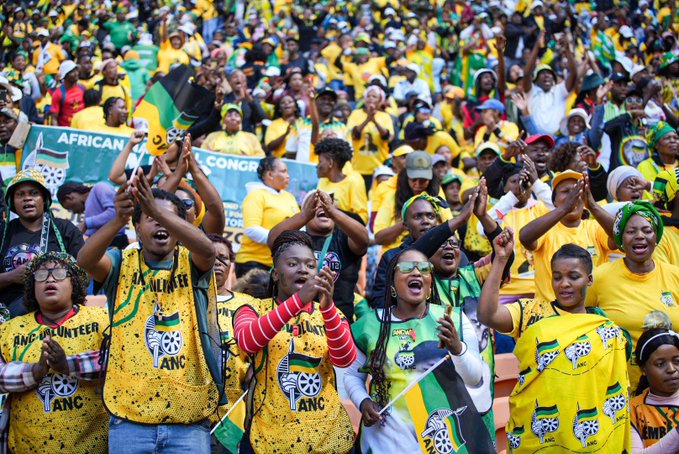
(The Post News)- The African National Congress (ANC) is poised to dominate the 2026 local government elections, capitalizing on its strong support base and the perceived missteps of opposition parties. The party’s stance on national sovereignty, particularly in response to external influences, is resonating with voters, especially from the black majority.
The Democratic Alliance’s (DA) alignment with the United States and its association with AfriForum’s controversial campaign in America have likely alienated black voters, who view these moves as threats to South African sovereignty. The Economic Freedom Fighters (EFF) is grappling with internal strife, including the resignation of Deputy President Floyd Shivambu, which has weakened the party. The MK Party, led by former President Jacob Zuma, is also facing instability, with members leaving the party, further bolstering the ANC’s prospects.
The ANC is capitalizing on these sentiments, positioning itself as the protector of national interests. The party’s stance on issues like the Israel-Palestine conflict, as seen in the International Court of Justice (ICJ) case, may also be resonating with voters. Many South Africans are prioritizing national sovereignty and are wary of perceived external threats, including Donald Trump’s influence.
Key Factors Contributing to the ANC’s Advantage:
- Strong Support Base: The ANC’s established support base, particularly among the black majority, is a significant factor in its favor.
- Opposition Parties’ Challenges: The DA’s alignment with the US and AfriForum’s campaign, as well as the EFF’s internal strife, are working in the ANC’s favor.
- National Sovereignty: The ANC’s stance on national sovereignty is resonating with voters, who are prioritizing this issue.
The ANC’s support base is also likely to be boosted by the perception that South Africa is being isolated on the international stage, particularly with the US’s stance on the G20 meeting.
However, the ANC is facing a critical moment, with corruption allegations threatening to undermine its credibility and electoral strength ahead of the 2026 local government elections. Revelations from the State Capture Inquiry and Madlanga Commission of Inquiry have implicated top leaders, highlighting the need for the party to cleanse itself of corrupt elements.
To regain public trust, the ANC must take decisive action against corruption within its ranks. President Cyril Ramaphosa has acknowledged the party’s crisis, pledging to reform and prioritize ethical leadership, discipline, and anti-corruption efforts. The ANC has also implemented measures such as the “step aside” rule, requiring members accused of wrongdoing to relinquish their posts.
However, the road to recovery won’t be easy. Corruption is deeply entrenched in some municipalities, with organized networks exploiting weaknesses in procurement and contract management. The Auditor-General’s report highlights poor consequence management, material non-compliance, and high levels of irregular expenditure.
The ANC’s ability to address these challenges will be crucial in determining its electoral prospects. Voters are increasingly prioritizing service delivery and accountability, and the party’s failure to deliver may shift momentum to rival parties.
About the Author