IMG 20240704 WA0006
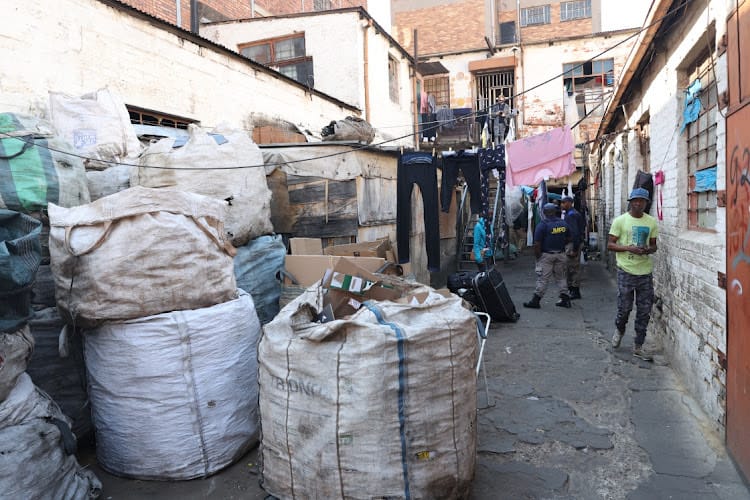
Picture Courtesy: (Thulani Mbele) The Commission investigating the Usindiso building commences its inaugural day, conducting official examinations of the allegedly ‘hijacked’ properties in the Johannesburg central business district.
(The Post News)- Residents occupying hijacked properties in the Johannesburg CBD express gratitude for not having to pay rent, as they struggle to make ends meet and cannot afford basic services that others take for granted.
Mirriam, a Zimbabwean national living in South Africa without documentation for the past five years, acknowledged that while their situation is far from ideal, residing in a hijacked building is preferable to the hardships faced by many others.
“At least we’re spared the burden of rent and unnecessary services. We make do with our humble abodes and scrape together a living however we can,” she said.
Previously, Mirriam worked as a domestic worker for an Ethiopian family in Pretoria. However, the family’s business in Marabastad shut down, and they returned to Ethiopia in 2022 following the husband’s passing.
“I was uncertain about my next steps, but a friend offered me a temporary place to stay here until I got back on my feet,” Mirriam explained.
The resident revealed this information on Wednesday during a formal examination by members of the Commission of Inquiry into the Usindiso building fire, which resulted in 76 fatalities.
The examination focused on allegedly seized properties in the CBD that are considered hazardous.
The commission’s objective is to probe fire safety risks and essential services at these occupied buildings, with a focus on preventing similar tragedies like the Usindiso fire from occurring in the future.
Accompanied by representatives from the Socio-Economic Rights Institute [SERI], the commissioners conducted a thorough examination of the buildings, assessing fire safety risks and evaluating the availability of essential services such as water, electricity, and waste management.
According to one of the commissioners, the inspection aimed to gain insight into the living conditions of the occupants.
The gathered data will be compiled into a comprehensive report, which will be submitted to the presiding officer and subsequently presented to the city authorities for implementation of recommendations.
For the past two years, Kiki Kwimdim, a citizen of Zimbabwe, has been residing at Industry House, a hijacked building in the Johannesburg central business district, without paying rent.
The building lacks essential services such as electricity and water, and residents have created makeshift partitions using curtains and cardboard boxes to demarcate small living spaces, effectively creating tiny “apartments” within the larger structure.
“When I arrived, my boyfriend collected me from Park Station, and I began living with him here. We don’t pay any rent or utilities, and everyone respects each other’s privacy. While there’s no electricity, we fetch water from the tap outside the building using buckets. Although the conditions aren’t ideal, our situation is preferable to that of many others,” Kwimdim explained.
She continued to explain how they maintain the property’s cleanliness, unlike other buildings she’s lived in, which often fell into disrepair.
“While fire safety is a concern, we’ve ensured ventilation by leaving openings from top to bottom, allowing air to circulate. I feel secure here, often leaving my room unlocked as I come and go, without worrying about theft or mischief. Everyone respects each other’s privacy, and it’s a peaceful environment,” said Kwimdim, who supports herself through various odd jobs.
These inspections come months after Mgcini Tshwaku, the MMC for public safety, revealed to Sowetan that the city was facing challenges in finding suitable alternative housing to relocate residents from occupied buildings.
About the Author