IMG 20240708 WA0004
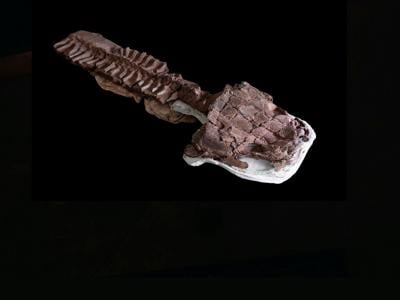
Picture courtesy: (KNDU) Fossil remains of a Gaiasia jennyae uncovered in Namibia.
(The Post News)- Approximately 280 million years ago, a massive lizard-like creature known as Gaiasia jennyae roamed the Earth. Unlike modern lizards, this animal had teeth.
The name “Gaiasia jennyae” is derived from the Gai-as rock formation in Namibia, where it was discovered, and it honors the late British paleontologist Jenny Clack, who studied tetrapods.
This animal lived amid the Permian Period and linked the swamps and lakes of present day day Namibia.
It trapped prey as a best predator in a chilly environment long some time recently the dinosaurs, it measured to at slightest 2.5 meters long, and in a few cases 4 meters based on what the analysts who had declared the disclosure of its fossilized remains.
The Gaiasia jennyae features a huge, circular and level cranium which had measured to more than 60 cm long and had interlocking teeth at the front of its mouth.
Concurring to postdoctoral individual in paleontology at the Field Museum in Chicago, Jason Pardo, claims that wide level heads in present day creatures more often than not are utilized to produce solid suction to snare prey by all of a sudden sucking it into their mouths.
The Gaiasia combines that with having a level head and the colossal teeth for catching conclusion slaughtering expansive prey.
The fossils of the Gaiasia jennyae was revealed in Namibia.
Due to the progressive development over time of the crustal plates that make the Earth’s external layer, which is known as plate tectonics, this range was indeed advance south where the Gaiasia lived, nearly indeed with Antarctica’s current northernmost point.
The bodies of water it occupied may have sat nearby patches of ice and icy masses.
Pardo says that within the distant south where Gaiasia lived, an ice age was coming to an conclusion and it was still very cold with expansive icy masses at indeed low altitudes.
Almost 100 million years before the Gaiasia, the primary land vertebrates had advanced from angle with meaty skins, these were known as stem tetrapods.
Amid this period, there are a few stem tetrapods that endured more particularly in farther places like Namibia at the time, the Gaiasia happened to be one of them.
Pardo proceeds to say that most of what they know around earthly life at this time comes from the antiquated equator, protected in rocks from Europe and North America.
From that, they had thought early tetrapods were caught within the tropics by their physiology, until they vanished in the midst of completion from recently advanced competitors.
Moreover he includes that the Gaiasia appears that typically not rectify, intaglio stem tetrapods were flourishing at tall scopes in exceptionally cold situations, and those biological systems were overwhelmed by primitive creatures.
All of this strengths them to reconsider a part almost early tetrapod advancement.
All of this presently deems the Gaiasia as a adamant holdover.
Pardo says that the Gaiasia is exceptionally distinctive from anything they have seen, so it may be a solitary survivor, but it may be portion of a dynamic environment of similarly bizarre creatures that were now not parts of the environment in the tropics.
About the Author