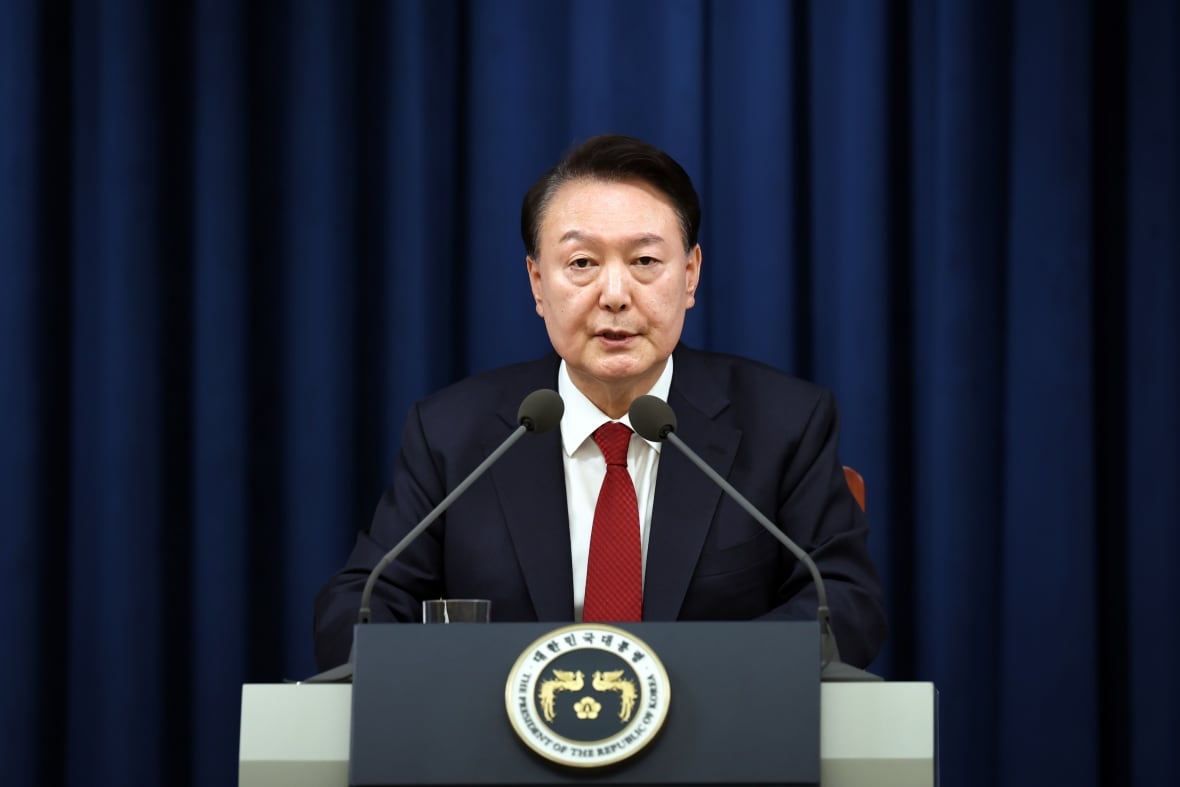
President Yoon Suk-Yeol speaks during the declaration of emergency martial law at the Presidential Office in Seoul on Tuesday. Image: Getty images
(The Post News)- On Wednesday, opposition members in South Korea filed a motion to impeach President Yoon Suk Yeol following his declaration of martial law, which has led the country into a political crisis.
Mr. Yoon’s announcement of martial law—during an unexpected televised speech late Tuesday—triggered political turmoil within one of America’s closest allies and recalled memories of the authoritarian postwar governments that suppressed peaceful opposition and established a police state. His scheme seemed to implode during a stressful night, and by the time the sun rose in Seoul on Wednesday, he had retreated.
Demonstrations persisted across Seoul as citizens of South Korea demanded the resignation of President Yoon Suk Yeol after his announcement and later retraction of martial law in the nation. Yoon’s ruling People Power Party also faced significant splits, as its leader demanded the dismissal of Defence Minister Kim Yong-hyun and the resignation of the entire cabinet, while the defence ministry reported that Kim has now proposed his resignation.
Demonstrators assembled at Gwanghwamun Square and in front of the national assembly on Wednesday, carrying signs with quotes like “Reinstate Democracy” and “Probe his rebellious actions without delay.” Opposition parties in South Korea submitted a request to impeach the president. During a live press briefing, representatives from six opposition parties, among them the leading Democratic Party, announced that the motion had been submitted as a matter of urgency. They recommended that the voting might occur as early as Friday, according to AFP.
New CCTV recordings showed disorderly scenes in South Korea’s parliament following the announcement of martial law. Staff members used sofas and fire extinguishers to keep soldiers with assault rifles and night vision goggles out of the national parliament, according to video footage.Yoon’s declaration of martial law, the first in over 40 years, recalled South Korea’s history of military-supported regimes, during which officials announced martial law and related orders that permitted them to deploy combat troops, tanks, and armored vehicles in public areas such as streets and schools to deter anti-government protests.
Until Tuesday night, there had been no scenes of military intervention since South Korea attained complete democracy in the late 1980s. The constitution also states that the president must cooperate when the National Assembly demands the repeal of martial law by a majority vote.
About the Author